

2025 Updated Verified Terraform-Associate-003 Downloadable Printable Exam Dumps
The Ultimate HashiCorp Terraform-Associate-003 Dumps PDF Review
HashiCorp Terraform-Associate-003 Exam Syllabus Topics:
| Topic | Details |
|---|---|
| Topic 1 |
|
| Topic 2 |
|
| Topic 3 |
|
NEW QUESTION # 29
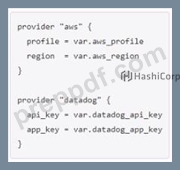
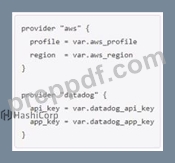
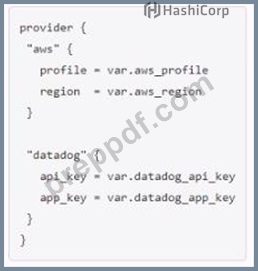
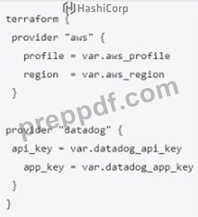
You ate creating a Terraform configuration which needs to make use of multiple providers, one for AWS and one for Datadog. Which of the following provider blocks would allow you to do this?
- A.
- B.
- C.
- D.
Answer: B
Explanation:
Option C is the correct way to configure multiple providers in a Terraform configuration. Each provider block must have a name attribute that specifies which provider it configures2. The other options are either missing the name attribute or using an invalid syntax.
NEW QUESTION # 30
terraform plan updates your state file.
- A. True
- B. False
Answer: B
Explanation:
Theterraform plancommand does not update the state file. Instead, it reads the current state and the configuration files to determine what changes would be made to bring the real-world infrastructure into the desired state defined in the configuration. The plan operation is a read-only operation and does not modify the state or the infrastructure. It is theterraform applycommand that actually applies changes and updates the state file.References= Terraform's official guidelines and documentation clarify the purpose of theterraform plancommand, highlighting its role in preparing and showing an execution plan without making any changes to the actual state or infrastructure .
NEW QUESTION # 31
What does Terraform not reference when running a terraform apply -refresh-only ?
- A. Credentials
- B. Cloud provider
- C. Terraform resource definitions in configuration files
- D. State file
Answer: C
Explanation:
Explanation
When running a terraform apply -refresh-only, Terraform does not reference the configuration files, but only the state file, credentials, and cloud provider. The purpose of this command is to update the state file with the current status of the real resources, without making any changes to them1.
NEW QUESTION # 32
Why does this backend configuration not follow best practices?
- A. You should not store credentials in Terraform configuration
- B. The backend configuration should contain multiple credentials so that more than one user can execute terraform plan and terraform apply
- C. An alias meta-argument should be included in backend blocks whenever possible
- D. You should use the local enhanced storage backend whenever possible
Answer: A
Explanation:
This is a bad practice, as it exposes your credentials to anyone who can access your configuration files or state files. You should use environment variables, credential files, or other mechanisms to provide credentials to Terraform.
NEW QUESTION # 33
You have multiple team members collaborating on infrastructure as code (IaC) using Terraform, and want to apply formatting standards for readability.
How can you format Terraform HCL (HashiCorp Configuration Language) code according to standard Terraform style convention?
- A. Manually apply two spaces indentation and align equal sign "=" characters in every Terraform file (*.tf)
- B. Write a shell script to transform Terraform files using tools such as AWK, Python, and sed
- C. Run the terraform fmt command during the code linting phase of your CI/CD process Most Voted
- D. Designate one person in each team to review and format everyone's code
Answer: C
Explanation:
The terraform fmt command is used to rewrite Terraform configuration files to a canonical format and style. This command applies a subset of the Terraform language style conventions, along with other minor adjustments for readability. Running this command on your configuration files before committing them to source control can help ensure consistency of style between different Terraform codebases, and can also make diffs easier to read. You can also use the -check and -diff options to check if the files are formatted and display the formatting changes respectively2. Running the terraform fmt command during the code linting phase of your CI/CD process can help automate this process and enforce the formatting standards for your team.
References = [Command: fmt]2
NEW QUESTION # 34
If a DevOps team adopts AWS CloudFormation as their standardized method for provisioning public cloud resoruces, which of the following scenarios poses a challenge for this team?
- A. The team is asked to manage a new application stack built on AWS-native services
- B. The organization decides to expand into Azure wishes to deploy new infrastructure
- C. The DevOps team is tasked with automating a manual, web console-based provisioning.
- D. The team is asked to build a reusable code based that can deploy resources into any AWS region
Answer: B
Explanation:
Explanation
This is the scenario that poses a challenge for this team, if they adopt AWS CloudFormation as their standardized method for provisioning public cloud resources, as CloudFormation only supports AWS services and resources, and cannot be used to provision infrastructure on other cloud platforms such as Azure.
NEW QUESTION # 35
You're writing a Terraform configuration that needs to read input from a local file called id_rsa.pub . Which built-in Terraform function can you use to import the file's contents as a string?
- A. templaTefil("id_rsa.pub")
- B. file("id_rsa.pub")
- C. fileset<"id_rsa.pub")
- D. filebase64("id_rsa.pub")
Answer: B
Explanation:
To import the contents of a local file as a string in Terraform, you can use the built-in file function. By specifying file("id_rsa.pub"), Terraform reads the contents of the id_rsa.pub file and uses it as a string within your Terraform configuration. This function is particularly useful for scenarios where you need to include file data directly into your configuration, such as including an SSH public key for provisioning cloud instances.
Reference = This information is a standard part of Terraform's functionality with built-in functions, as outlined in Terraform's official documentation and commonly used in various Terraform configurations.
NEW QUESTION # 36
Which of these statements about Terraform Cloud workspaces is false?
- A. They have role-based access controls
- B. You must use the CLI to switch between workspaces
- C. They can securely store cloud credentials
- D. Plans and applies can be triggered via version control system integrations
Answer: B
Explanation:
Explanation
The statement that you must use the CLI to switch between workspaces is false. Terraform Cloud workspaces are different from Terraform CLI workspaces. Terraform Cloud workspaces are required and represent all of the collections of infrastructure in an organization. They are also a major component of role-based access in Terraform Cloud. You can grant individual users and user groups permissions for one or more workspaces that dictate whether they can manage variables, perform runs, etc. You can create, view, and switch between Terraform Cloud workspaces using the Terraform Cloud UI, the Workspaces API, or the Terraform Enterprise Provider5. Terraform CLI workspaces are optional and allow you to create multiple distinct instances of a single configuration within one working directory. They are useful for creating disposable environments for testing or experimenting without affecting your main or production environment. You can create, view, and switch between Terraform CLI workspaces using the terraform workspace command6. The other statements about Terraform Cloud workspaces are true. They have role-based access controls that allow you to assign permissions to users and teams based on their roles and responsibilities. You can create and manage roles using the Teams API or the Terraform Enterprise Provider7. Plans and applies can be triggered via version control system integrations that allow you to link your Terraform Cloud workspaces to your VCS repositories. You can configure VCS settings, webhooks, and branch tracking to automate your Terraform Cloud workflow8. They can securely store cloud credentials as sensitive variables that are encrypted at rest and only decrypted when needed. You can manage variables using the Terraform Cloud UI, the Variables API, or the Terraform Enterprise Provider9. References = [Workspaces]5, [Terraform CLI Workspaces]6, [Teams and Organizations]7, [VCS Integration]8, [Variables]9
NEW QUESTION # 37
Which parameters does terraform import require? Choose two correct answers.
- A. Provider
- B. Path
- C. Resource ID
- D. Resource address
Answer: C,D
Explanation:
These are the parameters that terraform import requires, as they allow Terraform to identify the existing resource that you want to import into your state file, and match it with the corresponding configuration block in your files.
NEW QUESTION # 38
Terraform variables and outputs that set the description argument will store that description in the state file.
- A. True
- B. False
Answer: B
Explanation:
Comprehensive and Detailed in-Depth Explanation:The description argument for Terraform variables and outputs is purely for documentation purposes and isnotstored in the Terraform state file.
* Terraform variables and outputs can have descriptions for readability and clarity in .tf files.
* However, these descriptions are not retained in the Terraform state file.
* The state file only stores actual values and references needed for resource management, not metadata such as descriptions.
Official Terraform Documentation Reference:Terraform Variables - HashiCorp Documentation Terraform Outputs - HashiCorp Documentation
NEW QUESTION # 39
Define the purpose of state in Terraform.
- A. State lets you enforce resource configurations that relate to compliance policies
- B. State maps real world resources to your configuration and keeps track of metadata
- C. State stores variables and lets you quickly reuse existing code
- D. State codifies the dependencies of related resources
Answer: B
Explanation:
The purpose of state in Terraform is to keep track of the real-world resources managed by Terraform, mapping them to the configuration. The state file contains metadata about these resources, such as resource IDs and other important attributes, which Terraform uses to plan and manage infrastructure changes. The state enables Terraform to know what resources are managed by which configurations and helps in maintaining the desired state of the infrastructure.
References = This role of state in Terraform is outlined in Terraform's official documentation, emphasizing its function in mapping configuration to real-world resources and storing vital metadata .
NEW QUESTION # 40
When you initialize Terraform, where does it cache modules from the public Terraform Registry?
- A. In memory.
- B. In the .terraform sub-directory.
- C. In the /tmp directory.
- D. They are not cached.
Answer: B
Explanation:
* Terraformdownloads modules and providersinto the .terraform directory inside the working directory.
* A (/tmp/)- Incorrect; modules arenot stored temporarily.
* C (In memory)- Incorrect; modules persist on disk.
* D (Not cached)- Incorrect; Terraformdoes cache modulesfor efficiency.
Official Terraform Documentation Reference:
Terraform Module Caching
NEW QUESTION # 41
You decide to move a Terraform state file to Amazon S3 from another location. You write the code below into a file called backend.tf.
Which command will migrate your current state file to the new S3 remote backend?
- A. terraform refresh
- B. terraform init
- C. terraform push
- D. terraform state
Answer: B
Explanation:
This command will initialize the new backend and prompt you to migrate the existing state file to the new location3. The other commands are not relevant for this task.
NEW QUESTION # 42
terraform destroy is the only way to remove infrastructure.
- A. True
- B. False
Answer: B
Explanation:
While terraform destroy is a common way to remove infrastructure, it isnot the only way.
* You can also remove resources bydeleting them from the configuration and running terraform apply.
* Manually deleting resources in the cloud provider can also remove infrastructure (but Terraform won't be aware unless the state is updated).
Official Terraform Documentation Reference:
terraform destroy - HashiCorp Documentation
NEW QUESTION # 43
What value does the Terraform Cloud private registry provide over the public Terraform Module Registry?
- A. The ability to tag modules by version or release
- B. The ability to share modules with public Terraform users and members of Terraform Cloud Organizations
- C. The ability to share modules publicly with any user of Terraform
- D. The ability to restrict modules to members of Terraform Cloud or Enterprise organizations
Answer: D
Explanation:
The Terraform Cloud private registry provides the ability to restrict modules to members of Terraform Cloud or Enterprise organizations. This allows you to share modules within your organization without exposing them to the public. The private registry also supports importing modules from your private VCS repositories. The public Terraform Module Registry, on the other hand, publishes modules from public Git repositories and makes them available to any user of Terraform. References = : Private Registry - Terraform Cloud : Terraform Registry - Provider Documentation
NEW QUESTION # 44
If a module declares a variable with a default, that variable must also be defined within the module.
- A. True
- B. False
Answer: B
Explanation:
A module can declare a variable with a default value without requiring the caller to define it. This allows the module to provide a sensible default behavior that can be customized by the caller if needed. References =
[Module Variables]
NEW QUESTION # 45
......
Achive your Success with Latest Terraform-Associate-003 Exam: https://passcertification.preppdf.com/HashiCorp/Terraform-Associate-003-prepaway-exam-dumps.html