

2026 Latest AB-731 Exam Dumps Recently Updated 55 Questions
Microsoft AB-731 Real 2026 Braindumps Mock Exam Dumps
Microsoft AB-731 Exam Syllabus Topics:
| Topic | Details |
|---|---|
| Topic 1 |
|
| Topic 2 |
|
| Topic 3 |
|
NEW QUESTION # 33
Your company uses a fine-tuned generative AI solution trained on data that is representative of the general population.
You discover that some of the generated responses include inappropriate or exclusionary language based on ableist assumptions.
You need to prevent the inappropriate responses. Your solution must minimize costs.
What should you do?
- A. Apply a newer version of the generative AI model.
- B. Create a new version of the solution that is trained on only inclusive and representative content.
- C. Create a new version of the solution that is trained on only exclusionary content.
- D. Apply a content-moderation filter.
Answer: D
Explanation:
Implementing a content moderation filter is a critical strategy for fine-tuned generative AI to prevent the output of inappropriate or exclusionary language, including content rooted in ableist assumptions. These filters serve as a "digital safety layer" that intercepts biased or harmful material before it reaches the user.
How Filters Address Ableism and Exclusion
Contextual Detection: Modern filters using Large Language Models (LLMs) and Natural Language Processing (NLP) can detect subtle discriminatory phrases and slurs that traditional keyword filters might miss.
Policy-Driven Guardrails: Developers can use tools like the Lakera Guard Content Safety template to apply specific policies that flag and block ableist speech in real-time.
Customizable Classifiers: Services such as Azure AI Content Safety allow for the detection of
"abusive, derogatory, or discriminatory language" through trained statistical models.
Personalized Moderation: Emerging tools are being designed specifically to help disabled users filter out ableist hate and harassment tailored to their unique experiences.
Reference:
https://www.lakera.ai/blog/content-moderation
NEW QUESTION # 34
You plan to meet with stakeholders to discuss how generative AI can benefit your company. You need to provide a relevant description of generative AI. Which description should you use?
- A. Generative AI is designed to recommend products based on user behavior.
- B. Generative AI is designed to predict future trends based on historical data.
- C. Generative AI is designed to translate documents into other languages.
- D. Generative AI is designed to generate responses based on a user's natural language prompts.
Answer: D
Explanation:
Generative AI's defining capability is producing new content (text, images, code) in response to instructions-most commonly provided as natural language prompts. Option A best captures that general- purpose description for stakeholders: users ask questions or provide instructions, and the system generates responses or drafts content accordingly.
B is a specific application (translation) that generative AI can do, but it's not the defining description. C describes predictive analytics/forecasting, which is a different AI category. D describes recommendation systems, typically driven by user behavior and ranking algorithms, which can be enhanced by AI but is not the core definition of generative AI.
NEW QUESTION # 35
Hotspot Question
For each of the following statements, select Yes if the statement is true. Otherwise, select No.
NOTE: Each correct selection is worth one point.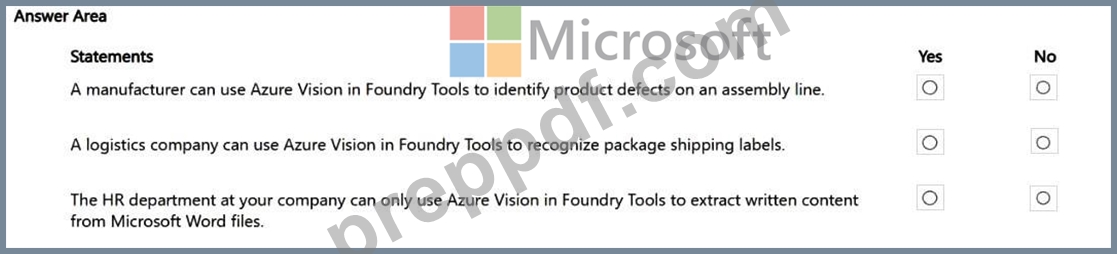
Answer:
Explanation: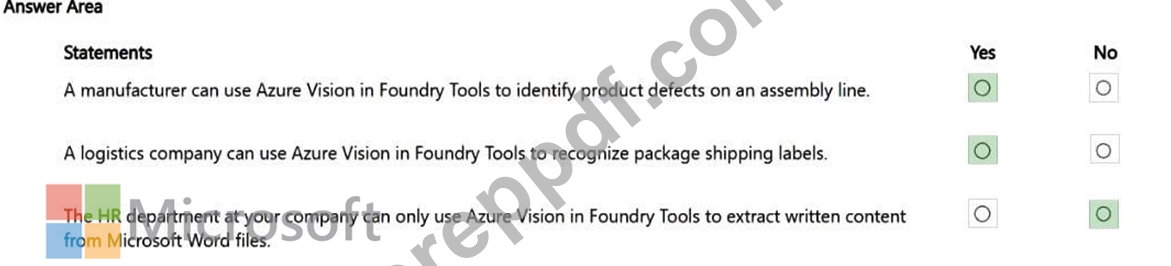
Explanation:
Box 1: Yes
Yes - A manufacturer can use Azure Vision in Foundry Tools to identify product defects on an assembly line.
A manufacturer can use Azure Vision in Foundry Tools (formerly part of Azure AI Services, now integrated within the AI Foundry toolkit) to identify product defects on an assembly line. This solution automates visual inspections to detect anomalies such as surface scratches, cracks, misalignments, or missing components in real time.
Box 2: Yes
Yes - A logistics company can use Azure Vision in Foundry Tools to recognize package shipping labels.
A logistics company can use Azure Vision in Foundry Tools (part of the broader Azure AI services suite) to recognize, interpret, and digitize package shipping labels. By integrating Azure's advanced AI with Palantir Foundry, firms can automate manual data entry, track shipments, and improve operational efficiency.
Box 3: No
No - The HR department at your company can only use Azure Vision in Foundry Tools to extract written content from Microsoft Word files.
Azure Vision in Foundry Tools is primarily designed for images, while its sibling tool, Document Intelligence, handles Microsoft Word files.
Reference:
https://datalabs.io/azure-ai-for-smart-manufacturing-defect-detection-with-computer-vision
https://learn.microsoft.com/en-us/azure/ai-services/computer-vision/overview
https://learn.microsoft.com/en-us/azure/ai-services/computer-vision/concept-ocr
NEW QUESTION # 36
For each of the following statements, select Yes if the statement is true. Otherwise, select No. NOTE: Each correct selection is worth one point.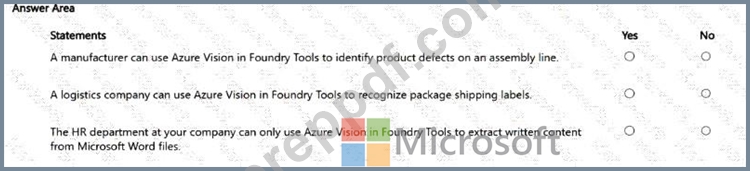
Answer:
Explanation: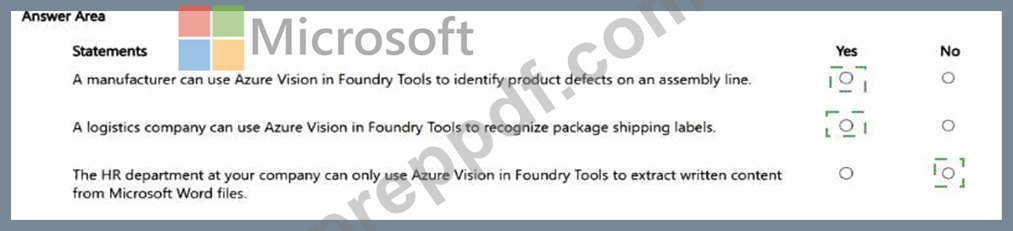
Explanation:
Answer Area
* A manufacturer can use Azure Vision in Foundry Tools to identify product defects on an assembly line.
answer: Yes
* A logistics company can use Azure Vision in Foundry Tools to recognize package shipping labels.
answer: Yes
* The HR department at your company can only use Azure Vision in Foundry Tools to extract written content from Microsoft Word files. answer: No Azure Vision in Foundry Tools provides computer vision capabilities to analyze images, including identifying visual features and reading text with OCR. Because it is designed to "analyze images" and support vision scenarios, it can be applied to manufacturing quality inspection use cases where the goal is to detect anomalies/defects from images captured on a production line. This aligns with statement 1 being Yes .
Statement 2 is also Yes because recognizing shipping labels is fundamentally text extraction from images (often plus some layout/field parsing). Azure Vision supports optical character recognition (OCR) to read printed text from images, and Microsoft documentation explicitly notes OCR can extract text from images such as product labels and similar real-world text surfaces-making shipping labels a direct fit.
Statement 3 is No because it is incorrectly restrictive. Azure Vision is not limited to extracting written content from Word documents, nor is OCR restricted to Word files. Vision capabilities apply broadly to images (and, depending on the capability, various document/image inputs) for tasks like image analysis and text recognition. HR could use it for many scenarios such as extracting text from scanned images, photos, or other visual inputs-not "only" Word files.
NEW QUESTION # 37
For each of the following statements, select Yes if the statement is true. Otherwise, select No. NOTE: Each correct selection is worth one point.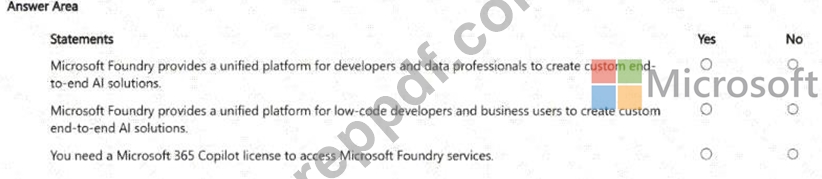
Answer:
Explanation: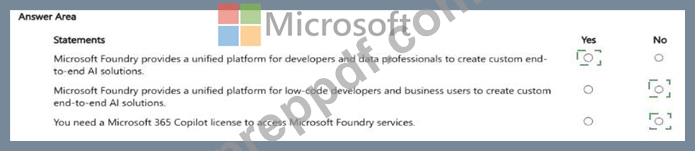
Explanation:
Answer Area
* Microsoft Foundry provides a unified platform for developers and data professionals to create custom end-to-end AI solutions. answer: Yes
* Microsoft Foundry provides a unified platform for low-code developers and business users to create custom end-to-end AI solutions. answer: No
* You need a Microsoft 365 Copilot license to access Microsoft Foundry services. Answer: No
* Yes - Microsoft Foundry is positioned by Microsoft as a unified AI platform for building, deploying, and scaling AI apps and agents, with enterprise governance in a single environment. Microsoft explicitly describes Foundry as enabling developers (and, in broader descriptions, data professionals
/enterprises) to build and operate AI solutions end-to-end, which aligns with the statement.
* No - While Foundry can streamline AI development workflows and may include experiences that reduce complexity, the statement specifically targets low-code developers and business users creating custom end-to-end AI solutions. In Microsoft's ecosystem, that "low-code/business-user" agent/app- building lane is more directly associated with tools like Copilot Studio/Power Platform , whereas Foundry is primarily presented as the platform for developers and technical teams building and governing AI solutions. Therefore, as written, the statement is not the best characterization.
* No - Access to Microsoft Foundry services is not gated by a Microsoft 365 Copilot license. Foundry is part of the Azure AI platform experience (formerly Azure AI Studio) and is accessed through Azure, using Azure subscription-based service consumption. Microsoft 365 Copilot licensing is for Microsoft
365 Copilot experiences, not a prerequisite to use Foundry services.
NEW QUESTION # 38
Your company plans to implement a proof of concept (PoC) agent that uses Azure OpenAI.
The solution must start small and provide flexibility to scale usage as demand grows.
Which pricing model should you use?
- A. Standard (On-Demand)
- B. Provisioned (PTUs)
- C. Batch API
- D. Microsoft 365 Copilot
Answer: A
Explanation:
The Standard (On-Demand) tier is the best choice for this scenario because it follows a pay-as- you-go consumption model. This allows a company to start a Proof of Concept (PoC) with virtually zero upfront cost or commitment, paying only for the tokens processed. As demand grows, the service provides the flexibility to scale without needing to manage complex capacity planning early on.
Reference:
https://azure.microsoft.com/en-us/products/ai-foundry/models/openai
NEW QUESTION # 39
Your company uses a generative AI solution.
You need to improve the quality of responses by using grounding.
Which statement accurately describes how grounding improves accuracy and relevancy?
- A. specifies the strengths and weaknesses of the AI model
- B. explains how and why AI models generate content
- C. anchors the responses in specific data sources
- D. references a diverse set of people, disciplines, and perspectives
Answer: C
Explanation:
Grounding is a critical technique for improving the accuracy and relevance of generative AI solutions by linking or "anchoring" the large language model's (LLM) outputs to specific, verified, and up-to-date data sources. Without grounding, LLMs rely on their pre-trained, static, and often outdated knowledge, leading to "hallucinations"-confidently generated but incorrect, irrelevant, or fabricated information.
How Grounding Improves Accuracy and Relevance
Grounding transforms a general-purpose AI into a specialized, trustworthy, and actionable tool by providing the following benefits:
Reduces Hallucinations: By forcing the model to anchor its responses in provided data-such as internal documents, databases, or live web searches-grounding significantly reduces the likelihood of the model creating false information.
Enhances Contextual Relevance: Grounded models can access domain-specific, private data (e.g., CRM records, internal wikis, proprietary PDFs) rather than just public, general knowledge.
Ensures Data Freshness: Instead of relying on a static, old training cut-off date, grounding (often via Retrieval-Augmented Generation or RAG) enables the model to access the latest, real-time information, such as current inventory, updated policies, or recent news.
Provides Auditability and Trust: Grounded systems frequently provide citations or links to the exact source material used to generate the answer, allowing users to verify the information and increasing trust in the system.
Reference:
https://portkey.ai/blog/llm-grounding-for-accurate-outputs/
NEW QUESTION # 40
Hotspot Question
Select the answer that correctly completes the sentence.
Answer:
Explanation:
Explanation:
Box: uses reasoning capabilities to generate deep insights based on organizational data and the web.
The Researcher agent in Microsoft 365 Copilot __________________.
The Researcher agent in Microsoft 365 Copilot is specifically engineered as a "deep reasoning" specialist to handle complex, multi-step research tasks that go far beyond a simple Here is how it operates differently from the standard Copilot experience:
*-> Deep Reasoning: It utilizes advanced models (like OpenAI's deep research models) and chain-of-thought reasoning to develop a plan, evaluate context, and weigh evidence before generating a response.
*-> Dual-Source Grounding: It simultaneously scours the public web and your organizational data (emails, Teams chats, SharePoint files, and meetings) via Microsoft Graph.
Structured Outputs: Unlike a chat response, it produces comprehensive, source-cited reports with professional formatting, including headings and sometimes visuals.
Interactive Refinement: The agent often starts by asking clarifying questions to narrow its scope, ensuring the final deep-dive report actually matches your specific intent.
Extended Processing: It intentionally takes longer-sometimes minutes instead of seconds-to perform the "heavy lifting" of synthesizing disparate data points into a cohesive insight.
Reference:
https://learn.microsoft.com/en-us/copilot/microsoft-365/researcher-agent
NEW QUESTION # 41
You need to create a custom Azure Machine Learning model. The data used to train the model is consistent and uniform.
What should you do first?
- A. Evaluate the model.
- B. Tune hyperparameters.
- C. Prepare the training data.
- D. Deploy the model.
- E. Train the model.
Answer: C
Explanation:
The first step in creating a custom Azure Machine Learning model trained on your data is to acquire and prepare the data. This involves activities such as:
Data Collection: Gathering the relevant data from its sources, such as databases, streaming sources, or Azure Blob storage.
Data Cleaning and Preprocessing: Even with consistent and uniform data, you will need to perform steps like handling missing values, removing duplicates, and ensuring standardization.
Data Transformation and Feature Engineering: Converting the raw data into a format suitable for the chosen machine learning algorithm and creating new features that can improve model performance.
Data Splitting: Dividing the dataset into separate training, validation, and testing sets so the model can be trained on one portion and evaluated on data it hasn't seen before.
Note:
Once the data is prepared and ready, the subsequent steps in Azure Machine Learning typically involve:
1. Setting up an Azure Machine Learning workspace if you don't already have one.
2. Creating a data asset within the workspace that points to your data in Azure storage.
3. Configuring compute resources for training the model.
4, Selecting an appropriate model algorithm and writing a training script (or using automated ML features).
5. Training and tuning the model using the prepared data and compute resources Reference:
https://medium.com/@offpagework1.datatrained/building-custom-r-models-in-azure-machine- learning-is-easy-e548598c6325
NEW QUESTION # 42
Your company receives thousands of scanned invoices each month. You need to recommend an AI solution that can automatically extract key details, such as invoice numbers, vendor names, and total amounts. What is the best solution to recommend? More than one answer choice may achieve the goal. Select the BEST answer.
- A. Azure Vision in Foundry Tools
- B. Azure AI Search
- C. Azure Document Intelligence in Foundry Tools
- D. Azure Machine Learning
Answer: C
Explanation:
For scanned invoices, the requirement is structured field extraction (invoice number/ID, vendor, totals) from document images or PDFs at scale. The best fit is Azure Document Intelligence because it is purpose- built for document processing and provides prebuilt invoice models that combine OCR with layout/structure understanding to extract common invoice fields into a structured output. Microsoft's invoice model is explicitly designed to analyze invoices (including scanned images) and return key fields and line items in structured form, which directly maps to this scenario.
Azure Vision (B) can perform OCR and basic image analysis, but OCR alone typically returns text without robust invoice-specific field interpretation (e.g., reliably identifying "Invoice ID" vs. "Order ID," totals vs.
subtotals, vendor vs. ship-to). Document Intelligence is optimized for advanced document structure extraction and is therefore the "best" single recommendation.
Azure AI Search (C) focuses on indexing and retrieval/knowledge mining across a corpus; it's not the primary service for extracting invoice fields for downstream processing. Azure Machine Learning (D) could be used to build a custom model, but that adds cost and time compared with a prebuilt invoice extractor designed for this document type.
NEW QUESTION # 43
Your company receives thousands of scanned invoices each month.
You need to recommend an AI solution that can automatically extract key details, such as invoice numbers, vendor names, and total amounts.
What is the best solution to recommend? More than one answer choice may achieve the goal.
Select the BEST answer.
- A. Azure Vision in Foundry Tools
- B. Azure AI Search
- C. Azure Document Intelligence in Foundry Tools
- D. Azure Machine Learning
Answer: C
NEW QUESTION # 44
You need to recommend a service that supports indexing information and knowledge mining by extracting insights from documents. What should you recommend?
- A. Azure AI Search
- B. Azure Vision in Foundry Tools
- C. Microsoft Foundry
- D. Azure Document Intelligence in Foundry Tools
Answer: A
Explanation:
The requirement has two key phrases: indexing information and knowledge mining by extracting insights from documents . The Microsoft service purpose-built for this is Azure AI Search (formerly Azure Cognitive Search), which provides a search index over your content and supports "AI enrichment" workflows to extract and structure insights from documents during indexing.
Azure AI Search can ingest content from common enterprise sources (files, blobs, databases), build searchable indexes, and enrich the indexed content using built-in skills or integrated AI capabilities-such as entity recognition, key phrase extraction, language detection, and OCR (depending on the pipeline). This is exactly what "knowledge mining" refers to: turning large volumes of unstructured documents into structured, searchable knowledge that applications and users can query.
The other choices are partial fits: Azure Vision focuses on image/video analysis, not general document indexing. Azure Document Intelligence is excellent for extracting fields/tables from forms and documents, but on its own it does not provide the full indexing/search and knowledge mining layer across a corpus.
Microsoft Foundry is an overarching platform for building AI apps/agents; it can incorporate search, but the specific service that directly delivers indexing + knowledge mining is Azure AI Search .
NEW QUESTION # 45
Your company plans to implement a proof of concept PoC agent that uses Azure OpenAI. The solution must start small and provide flexibility to scale usage as demand grows. Which pricing model should you use?
- A. Standard On-Demand
- B. Batch API
- C. Provisioned PTUs
- D. Microsoft 365 Copilot
Answer: A
Explanation:
For a proof of concept , the key requirements are low commitment , quick start , and the ability to scale up or down as you learn what real usage looks like. Azure OpenAI Standard On-Demand pricing is designed for exactly that: you pay per token consumed (input and output) on a pay-as-you-go basis, which makes it ideal when demand is uncertain or variable-typical in early pilots and PoCs.
By contrast, Provisioned (PTUs) is best when you have well-defined, predictable throughput and latency requirements -usually a more mature, production workload. PTUs involve reserving model processing capacity to achieve consistent performance and more predictable costs, which is usually premature for a PoC where actual traffic patterns are not yet known.
Batch API is optimized for asynchronous high-volume jobs with a target turnaround (for example, up to 24 hours) and discounted pricing. That's great for offline processing, but it does not match an interactive "agent" PoC that typically needs near-real-time responses and iterative testing.
Microsoft 365 Copilot is a separate SaaS licensing model and is not the Azure OpenAI pricing model for building your own agent solution.
NEW QUESTION # 46
Hotspot Question
Select the answer that correctly completes the sentence.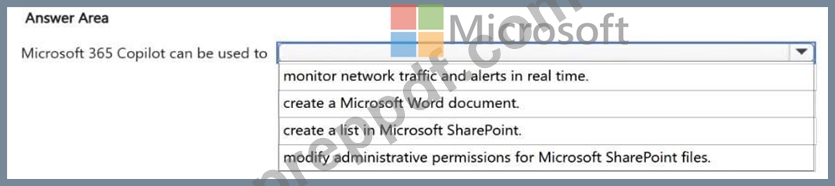
Answer:
Explanation: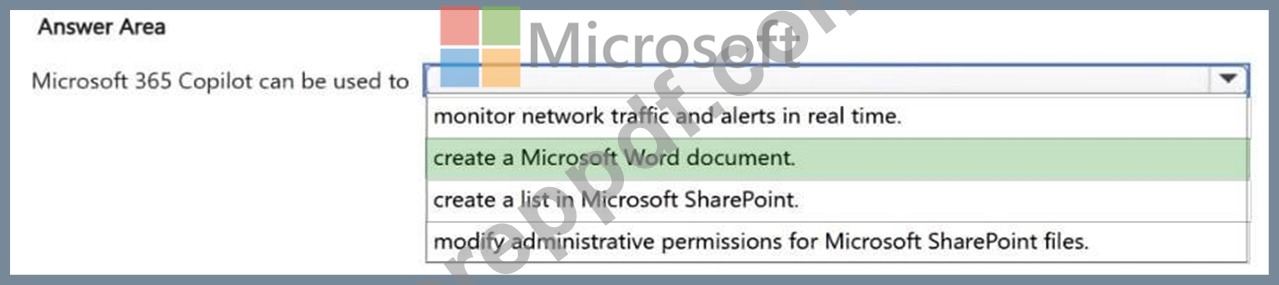
Explanation:
Box: create a Microsoft Word document
Microsoft 365 Copilot can be used to _______________.
Microsoft 365 Copilot can be used to create, draft, and refine Microsoft Word documents through several methods:
Draft from Scratch: You can start a new blank document and use the Draft with Copilot box (accessible via the Copilot icon or Alt + I) to enter a natural language prompt, such as "Write a sales proposal for a new product".
Reference Existing Files: You can ask Copilot to draft a new document based on up to three existing files (like a PowerPoint or another Word doc) by using the Reference a file button or typing / followed by the filename in the prompt box.
Chat-to-Document: Using the Copilot Agent in Word, you can start a project in a chat interface to ideate and then seamlessly transition that content into a structured Word document.
Template Creation: Within the Microsoft 365 Copilot app, you can select "Create" to start a document from a pre-defined template.
Reference:
https://support.microsoft.com/en-us/office/welcome-to-copilot-in-word-2135e85f-a467-463b-b2f0- c51a46d625d1
NEW QUESTION # 47
- For each of the following statements, select Yes if the statement is true. Otherwise, select No. NOTE: Each correct selection is worth one point.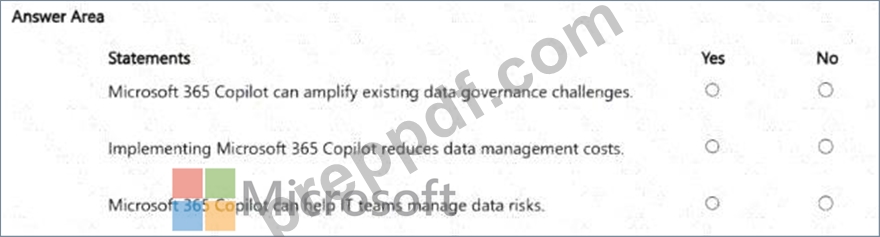
Answer:
Explanation: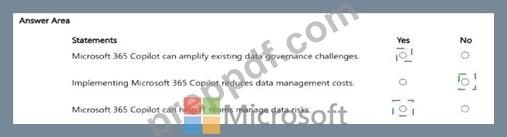
Explanation:
Answer Area
Microsoft 365 Copilot can amplify existing data governance challenges.
answer: Yes
Implementing Microsoft 365 Copilot reduces data management costs.
answer: No
Microsoft 365 Copilot can help IT teams manage data risks.
answer: Yes
Yes - Copilot relies on the permissions, sharing links, and content exposure that already exist in Microsoft
365. If an organization has oversharing (for example, broadly accessible SharePoint sites, poorly scoped Teams, unmanaged external sharing, or excessive access rights), Copilot can surface that content more easily through natural-language querying. In other words, Copilot doesn't create new permissions, but it can increase visibility of governance gaps and make the impact of weak information architecture more apparent.
No - It is not accurate to claim that implementing Copilot inherently reduces data management costs.
Adoption often requires up-front investment in data hygiene, sensitivity labeling, retention, permission cleanup, DLP, and change management. Some organizations may realize productivity gains or reduced effort over time, but "reduces costs" is not a guaranteed outcome and depends heavily on the current state of governance, the scale of remediation needed, and how Copilot is rolled out.
Yes - Copilot can support IT risk management when deployed with the right controls: identity and access governance, sensitivity labels, DLP policies, retention, auditing, and compliance tooling. Because Copilot operates within the Microsoft 365 security/compliance boundary and honors existing access controls, IT can apply centralized policies to reduce leakage risk and improve overall control of how organizational data is accessed and used.
NEW QUESTION # 48
Hotspot Question
For each of the following statements, select Yes if the statement is true. Otherwise, select No.
NOTE: Each correct selection is worth one point.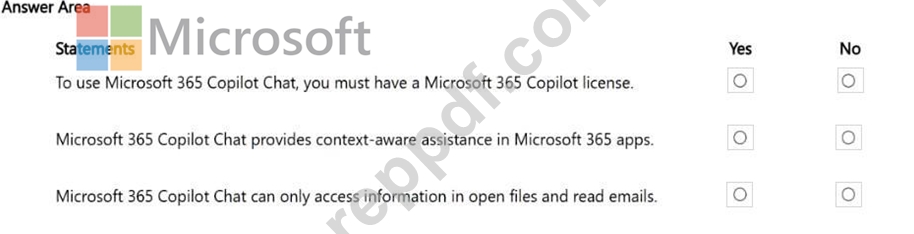
Answer:
Explanation: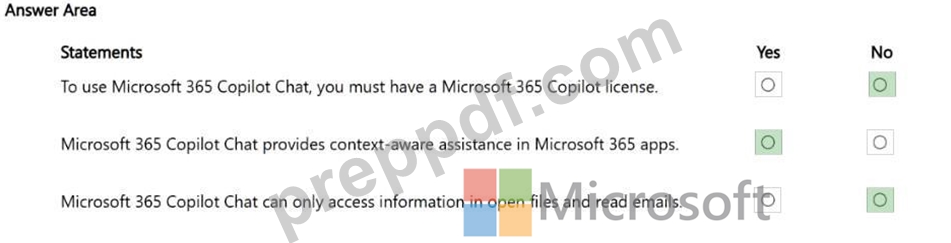
Explanation:
Box 1: No
To use Microsoft 365 Copilot chat, you must have a Microsoft Copilot license.
You do not necessarily need a separate "Microsoft 365 Copilot" add-on license to use the Copilot Chat feature.
Microsoft now includes a baseline version of Copilot Chat at no additional cost for users with eligible Microsoft 365 and Office 365 subscriptions.
Here is how the licensing impacts your experience:
*-> Without a Copilot Add-on License: You can still use Copilot Chat if you have a qualifying base subscription (such as Business Standard, E3, or E5). This version is web-grounded, meaning it can answer questions using public internet data and context from your currently open file, but it cannot search through your entire organization's emails, meetings, or files.
With a Microsoft 365 Copilot License: Adding this paid license transforms Copilot into a work- grounded assistant. It gains the ability to "reason" across your entire Microsoft Graph-searching your private inbox, calendar, and SharePoint documents to provide context-aware answers.
Box 2: Yes
Yes - Microsoft 365 Copilot chat provides context-aware assistance in Microsoft 365 apps.
Microsoft 365 Copilot chat is an AI-powered, context-aware assistant embedded directly into Microsoft 365 apps (Word, Excel, PowerPoint, Outlook, OneNote) to streamline workflow, summarize content, and create documents. It operates within a secure environment, using organizational data-including emails, chats, and files-to provide tailored assistance, with or without a separate paid add-on license.
Key Features and Capabilities:
*-> Context-Aware Assistance: Interacts with the user's active files (e.g., summarizing an open Word document) and Microsoft Graph data to provide relevant, in-the-moment help.
Integrated Apps: Available in a side pane in Word, Excel, PowerPoint, Outlook, and OneNote.
Content Generation & Summarization: Helps draft content, revise tones, summarize long email threads, and analyze data.
Secure Data Usage: Built-in with enterprise-grade data protection, ensuring that user data remains secure and is not used to train public models.
Functionality: Capabilities include uploading images, expanding input boxes, and providing quick access to agents and page-creation tools.
Box 3: No
No - Microsoft 365 Copilot chat can only access information in open files and read emails.
While Copilot does work with active, open content, it is designed to ground its responses in a much broader range of organizational data. It uses the Microsoft Graph to access, search, and summarize data across your entire Microsoft 365 tenant, provided you have the necessary permissions.
Reference:
https://www.microsoft.com/en-us/microsoft-365-copilot/pricing/enterprise
https://support.microsoft.com/en-gb/topic/how-copilot-chat-works-with-and-without-a-microsoft-
365-copilot-license-5810b659-fbe0-48ee-9fe6-d731fe86cdeb
https://learn.microsoft.com/en-us/copilot/microsoft-365/microsoft-365-copilot-privacy
NEW QUESTION # 49
Your company plans to use generative AI to help project managers and engineers work with construction blueprints stored as PDF files. You need to recommend a generative AI solution that processes both images and text, summarizes building design, answers questions, and extracts information such as locations of electrical, heating, and plumbing systems. What should you recommend?
- A. a text completion solution
- B. a multi-modal solution
- C. a document summarization solution
- D. an optical character recognition OCR solution
Answer: B
Explanation:
Construction blueprints in PDFs often contain a mix of text, symbols, linework, and diagrams . The requirements include understanding both visual layout (where systems are located) and textual annotations , producing summaries, and answering Q & A. That combination requires a multimodal generative AI approach-models that can reason over images and text together. Therefore, A is best.
OCR alone (B) can extract printed text, but it won't reliably interpret diagram geometry, symbols, or spatial relationships (e.g., "electrical riser is on the east core near gridline B-4"). Text completion (C) is too generic and doesn't address image understanding. Document summarization (D) is only one requirement (summary) and still depends on first extracting/understanding both visual and textual elements.
A multimodal solution can ingest the PDF pages as images (or rendered page images) plus extracted text, then answer questions grounded in both modalities. In practice, you may combine OCR and layout extraction with a multimodal LLM so the model can reference drawing regions, legends, callouts, and system diagrams to produce accurate explanations and field extractions.
NEW QUESTION # 50
- For each of the following statements, select Yes if the statement is true. Otherwise, select No. NOTE: Each correct selection is worth one point.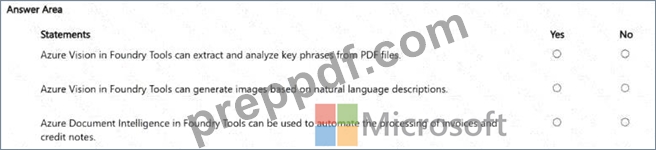
Answer:
Explanation: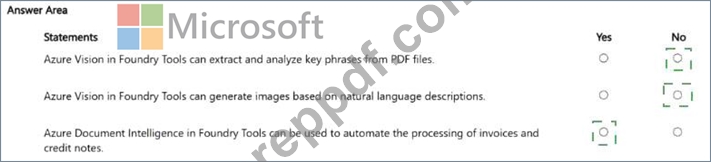
Explanation:
Answer Area
* Azure Vision in Foundry Tools can extract and analyze key phrases from PDF files. Answer: No
* Azure Vision in Foundry Tools can generate images based on natural language descriptions. Answer:
No
* Azure Document Intelligence in Foundry Tools can be used to automate the processing of invoices and credit notes. Answer: Yes
* No - Azure Vision in Foundry Tools focuses on computer vision tasks such as image analysis and OCR (reading text from images and documents). While it can extract text from scanned PDFs via OCR, key phrase extraction is a natural language processing capability provided by Azure Language in Foundry Tools , not Azure Vision. Key phrase extraction analyzes text to identify main concepts, which is a different service family than vision.
* No - Azure Vision can analyze existing images (for example, generate captions/descriptions of an image), but generating new images from a text prompt is a generative model capability (for example, DALL E through Azure OpenAI/Azure AI Foundry model endpoints), not an Azure Vision feature.
Vision describes what it "sees"; it doesn't synthesize new images from natural language.
* Yes - Azure Document Intelligence in Foundry Tools is designed for intelligent document processing
, including automating extraction of structured fields from financial documents. Microsoft provides prebuilt models for invoices and supports custom extraction for similar document types, which makes it suitable for automating workflows involving invoices and credit-note style documents (field extraction, validation, routing).
NEW QUESTION # 51
Select the answer that correctly completes the sentence.
Prompt engineering is the process of __________.
Answer:
Explanation:
Explanation:
crafting clear instructions to guide generative AI solutions in generating context-appropriate content.
Prompt engineering is fundamentally about how you communicate intent to a generative AI model so it produces outputs that meet business expectations. The best completion is "crafting clear instructions to guide generative AI solutions in generating context-appropriate content" because it captures the practical, day-to- day discipline: shaping the input (prompt) with the right task framing, constraints, context, and output format.
In real deployments, prompt engineering includes specifying the role and objective (for example, "act as a customer support agent"), providing the necessary context (product details, policy excerpts, audience), adding explicit requirements (tone, length, must/must-not statements), and defining structured output (JSON fields, bullet sections, headings). It can also include adding examples (few-shot prompting), clarifying what to do when information is missing, and instructing the model to cite only provided sources or to ask follow-up questions. These techniques reduce ambiguity, improve consistency, and lower the risk of hallucinations or off-brand responses.
The other options are not accurate definitions. "Integrating AI-powered tools into business workflows" describes solution adoption/integration, not prompt engineering. "Identifying and fixing errors in AI- generated content" is review/editing or quality assurance. "Designing, developing, and training generative AI models" is model development/ML engineering. Prompt engineering operates without changing model weights ; it's about steering model behavior through well-constructed instructions and context.
NEW QUESTION # 52
HOTSPOT - Select the answer that correctly completes the sentence.
Microsoft 365 Copilot can be used to __________.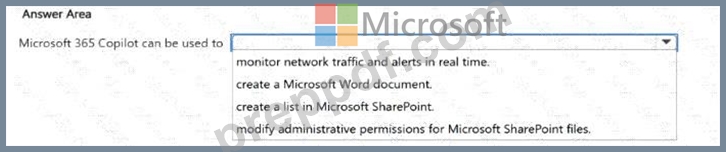
Answer:
Explanation: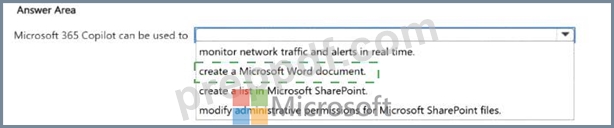
Explanation:
create a Microsoft Word document.
Microsoft 365 Copilot is a productivity-focused AI capability embedded across Microsoft 365 apps such as Word, Excel, PowerPoint, Outlook, and Teams. A core, common use case is drafting and generating documents in Word from prompts and existing context. Therefore, "create a Microsoft Word document" is the best completion.
The other options are not appropriate for Microsoft 365 Copilot's scope. "Monitor network traffic and alerts in real time" is a security/operations function more aligned to security monitoring tools and, in Microsoft's product set, closer to Microsoft Security Copilot or dedicated SIEM/SOAR platforms (for example, Microsoft Sentinel). "Modify administrative permissions for SharePoint files" is an admin/governance action that is intentionally protected by role-based access control and is not something end-user Copilot features are meant to perform as a default capability. "Create a list in Microsoft SharePoint" is closer, because Copilot can assist in generating content and can work within Microsoft 365 collaboration contexts; however, the most universally accurate and directly supported capability among the options is creating/drafting a Word document, which is a primary Copilot scenario in Word.
In short, Microsoft 365 Copilot is designed to help users create, summarize, rewrite, and transform content within Microsoft 365 apps, and document creation in Word is a canonical example of that value.
NEW QUESTION # 53
Your company has a Microsoft 365 subscription and uses Microsoft 365 Copilot Chat. Some users need to build and use declarative agents that can access work data. Which type of license should you recommend for the users?
- A. a Copilot Chat pay-as-you-go plan
- B. a Microsoft 365 Copilot add-on license
- C. Microsoft Copilot Studio user license
Answer: B
Explanation:
The requirement is specific: users must build and use declarative agents that can access work data (tenant data
/ organizational context). Microsoft's licensing guidance for Copilot extensibility ties use of declarative agents to having the appropriate Copilot entitlement that enables tenant grounding and organizational data access. In Microsoft's cost and licensing considerations for declarative agents, Microsoft states that to use a declarative agent, users must have a Microsoft 365 Copilot add-on license (or an equivalent Copilot Chat add- on path tied to eligible licensing). Therefore, among the provided options, the best recommendation is A.
Option B (Copilot Studio user license) is primarily about authoring/building agents in Copilot Studio, but it is not, by itself, the licensing prerequisite that grants end users the right to use those agents with full Microsoft
365 Copilot capabilities and work-data grounding inside the Microsoft 365 Copilot environment. Publishing
/building can be separate from the end-user entitlement to use the agent with organizational context.
Option C (Copilot Chat pay-as-you-go) can enable usage-based access to declarative agents in some configurations, but the question asks for the best license recommendation for users who need work-data access through declarative agents. The Microsoft 365 Copilot add-on is the straightforward, fully supported entitlement for that scenario.
NEW QUESTION # 54
- For each of the following statements, select Yes if the statement is true. Otherwise, select No. NOTE: Each correct selection is worth one point.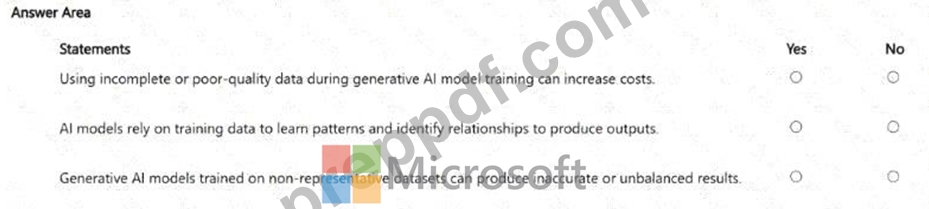
Answer:
Explanation: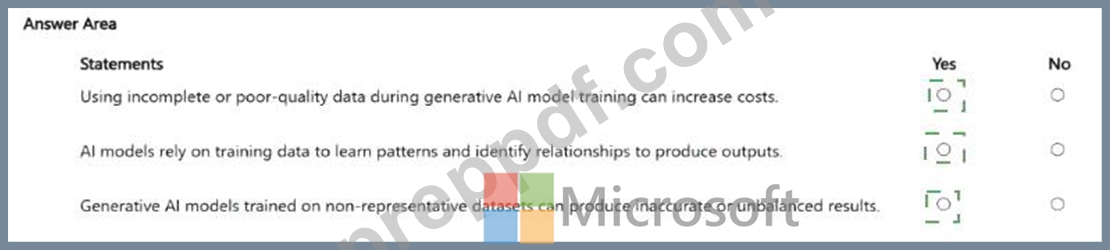
Explanation:
Answer Area
* Using incomplete or poor-quality data during generative AI model training can increase costs. Answer:
Yes
* AI models rely on training data to learn patterns and identify relationships to produce outputs. Answer:
Yes
* Generative AI models trained on non-representative datasets can produce inaccurate or unbalanced results. Answer: Yes
* Yes - Poor-quality or incomplete training data increases cost because it drives more iterations:
additional data cleaning, relabeling, re-training, and re-evaluation to reach acceptable performance. It can also increase operational costs after deployment if the model produces low-quality outputs that require human rework, escalations, or incident handling. In practice, data quality debt becomes model cost debt.
* Yes - Training data is the primary mechanism by which AI models learn statistical patterns and relationships. For generative models, the training corpus shapes language fluency, factual associations, style tendencies, and the kinds of content the model can produce. Without sufficient and appropriate training signals, outputs degrade.
* Yes - If the training dataset is not representative of the real-world population or business context, the model can systematically underperform for certain groups, topics, or edge cases. This can manifest as biased language, missing perspectives, and uneven accuracy, producing "unbalanced" results. That is why Responsible AI practice emphasizes representative data, evaluation across slices, and continuous monitoring.
NEW QUESTION # 55
- Select the answer that correctly completes the sentence.
An organization that runs continuous, large-scale workloads with Azure OpenAI models should choose the
__________ pricing model.
Answer:
Explanation:
Explanation:
Provisioned (PTUs)
For continuous, large-scale workloads, the key needs are predictable throughput, consistent latency, and cost/performance stability . Azure OpenAI Provisioned Throughput Units (PTUs) are designed for this scenario because you reserve model capacity to meet sustained demand. This reduces the risk of variability that can occur with purely on-demand usage during peak periods and provides a more predictable operating model when the workload is always "on" and high volume.
Standard (On-Demand) is best when usage is variable or you're starting small (PoCs, pilots, spiky workloads), because it is flexible pay-as-you-go but can be less predictable at sustained scale. Batch API is optimized for asynchronous, non-interactive processing where you can tolerate delayed results (for example, large offline summarization jobs), not for always-on, real-time interactions at scale.
Therefore, for continuous high-volume production workloads, Provisioned (PTUs) is the best pricing model choice.
NEW QUESTION # 56
You are exploring how Microsoft 365 Copilot uses Microsoft Graph to deliver AI-powered experiences.
Which information in Microsoft Graph can Copilot use by default?
- A. social media activity
- B. emails, files, meetings, and chats in Microsoft 365
- C. data stored in a file share
- D. content from public websites
Answer: B
Explanation:
Microsoft 365 Copilot is designed to work within the Microsoft 365 ecosystem and use organizational context that is already governed by Microsoft Entra ID, Microsoft 365 permissions, and compliance controls. By default, Copilot can use Microsoft Graph signals and content that exist in Microsoft 365 workloads the user already has access to-most commonly emails, files, meetings, and chats . That corresponds to A .
The key concept is permission-trimming: Copilot doesn't magically gain access to everything; it can only surface or use data that the signed-in user is permitted to access in Microsoft 365. This is what makes Copilot valuable for productivity scenarios-summarizing email threads, drafting replies, generating meeting recaps, creating documents from your files, or pulling context from Teams chats-because those artifacts are already part of daily work and already subject to tenant policies.
The other options are not "by default" Microsoft Graph content for Copilot: B (file shares) typically requires additional integration or migration into Microsoft 365 repositories or indexing via connectors; it's not inherently available. C is unrelated to Microsoft 365 tenant work data. D (public web) is not "information in Microsoft Graph"; web grounding is a separate capability and not the default Graph workload data source referenced here.
NEW QUESTION # 57
Which statement accurately describes the difference between a pretrained generative AI model and a fine-tuned generative AI model?
- A. A pretrained model is trained on broad datasets, while a fine-tuned model is adapted to perform well on a narrower, domain-specific dataset.
- B. A pretrained model is optimized for a specific task, while a fine-tuned model is designed for general-purpose use.
- C. A pretrained model requires labeled data, while a fine-tuned model does not.
- D. A pretrained model is faster to train than a fine-tuned model because the pretrained model uses fewer parameters.
Answer: A
Explanation:
Pretrained generative AI models are trained on massive, diverse datasets to gain foundational knowledge, while fine-tuned models take these pretrained weights and further train them on smaller, specific datasets to improve accuracy for narrow tasks or industries. This process aligns the model's output to specialized styles, domains, or tasks.
Key Differences and Details:
Pretrained Models (Foundational): These models (e.g., GPT-4) learn general language, concepts, and patterns from massive, broad datasets like Common Crawl. They are versatile but may lack expertise in specialized fields.
Fine-tuned Models: By adjusting the weights of a pretrained model on a smaller, labeled dataset, the model is tailored to specific applications, such as medical analysis, legal document review, or a particular brand voice.
Performance Benefits: Fine-tuning improves precision and reduces irrelevant outputs compared to a generic model.
Methodology: While pretraining is unsupervised or self-supervised, fine-tuning often uses supervised learning Reference:
https://www.ibm.com/think/topics/fine-tuning
NEW QUESTION # 58
......
Verified AB-731 Exam Dumps Q&As - Provide AB-731 with Correct Answers: https://passcertification.preppdf.com/Microsoft/AB-731-prepaway-exam-dumps.html