

300-425 Exam Questions - Real & Updated Questions PDF
Pass Guaranteed Quiz 2025 Realistic Verified Free Cisco
NEW QUESTION # 103
An engineer is designing a new wireless network. Based on the design, OfficeExtend AP functionality must be used. Which type of license must the Cisco 5520 WLC v8.3 have?
- A. Plus license
- B. Base license
- C. OfficeExtend AP license
- D. WPlus license
Answer: B
NEW QUESTION # 104
An engineer has configured guest anchoring for a newly created SSD however, the mobility tunnels are not up, and EPING is failing from the foreign WLC to the anchor WLC. Which traffic flow must be allowed at the firewall to enable the communication?
- A. TCP port 97
- B. IP protocol 97
- C. UDP port 16666
- D. UDP port 97
Answer: C
Explanation:
Mobility tunnels between Cisco Wireless LAN Controllers (WLCs) use UDP port 16666 for control messages and UDP port 16667 for data traffic. If EPING is failing, it indicates that the necessary ports are not open. Allowing UDP port 16666 through the firewall would enable the control messages required for establishing the mobility tunnels.
NEW QUESTION # 105
An engineer must create a multicampus architecture wireless design to accommodate 4500 access points for wireless data Which model controller the requirements to support all access points on one high availability controller setup?
- A. 0
- B. 1
- C. 2
- D. 3
Answer: C
Explanation:
The Cisco 8540 Wireless Controller is designed for large enterprise and high-density environments. It has the capacity to manage up to 6000 access points, making it suitable for a multicampus architecture that needs to accommodate 4500 access points. Its high availability features ensure that all access points can be supported on one controller setup with minimal downtime.
NEW QUESTION # 106
A wireless engineer is performing a post verification of a wireless network. Which two metrics does the engineer verify to ensure that the wireless network can support voice services? (Choose two.)
- A. The rate of retransmitted packets must be 15 percent or below.
- B. The client device must have at least an -65 dBm RSSI.
- C. The rate of retransmitted packets must be 20 percent or below.
- D. The coverage area must have a noise floor that does not exceed -87 dBm.
- E. The client device must have at least an -67 dBm RSSI.
Answer: C,E
Explanation:

NEW QUESTION # 107
Guest anchoring is configured for a newly created SSID for your company. It has been noticed that the mobility tunnels are not up, and that MPING fails from your foreign WLC to the anchor WLC. What is the reason that it is failing?
- A. A rule is needed at the firewall to allow UDP port 97 for communication to work.
- B. A rule is needed at the firewall to allow UDP port 16666 for communication to work.
- C. A rule is needed at the firewall to allow TCP port 97 for communication to work.
- D. A rule is needed at the firewall to allow TCP port 16666 for communication to work.
Answer: B
NEW QUESTION # 108
A network engineer is working for an enterprise where most of the laptops support 802.11v. To optimize the client roaming experience, configuration changes must be made on the corporate SSID to force clients to use the best APs based on the 802.11 v BSS transition message. Which configuration meets this requirement?
- A. Disable coverage hole detection and enable 802.11k for the corporate SSID.
- B. Enable the BSS transition option with an optimized roaming timer for the corporate SSID.
- C. Enable BSS transition for the SSID and disable dissociation imminent to avoid client disconnects.
- D. Enable coverage hole detection and BSS transition and disable dissociation imminent.
Answer: B
NEW QUESTION # 109
A wireless engineer is calibrating a floor using Cisco Prime Infrastructure. Which setting in the WLC must be disabled before the floor calibration is started?
- A. Tx Power Control
- B. Coverage Hole Detection
- C. Dynamic Channel Assignment
- D. CleanAir
Answer: A
NEW QUESTION # 110
When a wireless survey is conducted at a customer facility, signal attenuation in an area that is surrounded by thick glass walls is noted as 2dB. When Cisco Prime Infrastructure is configured, which obstacle must be placed in a map editor to represent the impact that the glass wall will have on the RF signal in the facility?
- A. light wall
- B. thick wall
- C. heavy door
- D. glass
Answer: D
Explanation:
When configuring Cisco Prime Infrastructure, to represent the impact of a thick glass wall with an attenuation of 2dB on the RF signal, the obstacle that should be placed in the map editor is glass. This is because the material-specific attenuation values are used to model the RF signal's behavior as it passes through different types of obstacles, and the thick glass wall's impact is best represented by the glass obstacle in the map editor.
NEW QUESTION # 111
A rapidly expanding company has tasked their network engineer with wirelessly connecting a new cubicle area with Cisco workgroup bridges until the wired network is complete. Each of 42 new users has a computer and VoIP phone. How many APs for workgroup bridging must be ordered to keep cost at a minimum while connecting all devices?
- A. 0
- B. 1
- C. 2
- D. 3
Answer: C
Explanation:
Explanation
So, each AP will have 25 clients. Minimum 4 APs are sufficient.
NEW QUESTION # 112
An engineer is designing a new wireless network. The network needs to meet these requirements: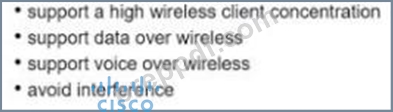
Which design approach should be taken?
- A. 5 GHz frequency band with channel bonding, to support 40 MHz channels
- B. 2.4 GHz frequency band without channel bonding, to support 20 MHz channels
- C. 5 GHz frequency band with channel bonding, to support 80 MHz channels.
- D. 5 GHz frequency band without channel bonding, to support 20 MHz channels
Answer: D
Explanation:
The design approach should use the 5 GHz frequency band without channel bonding to support 20 MHz channels. This provides a balance between network capacity and interference mitigation.
https://www.cisco.com/c/en/us/support/docs/wireless/4400-series-wireless-lan-controllers/108184-config-802-11n-wlc.html
NEW QUESTION # 113
A customer has noticed that Client Band Select is enabled and no clients are utilizing the 5 GHz band. Which three parameters must be met to ensure that wireless clients use the 5 GHz band? (Choose three.)
- A. Ensure that the co-channel interference has not exceeded -85 dBm.
- B. Ensure that channel bonding is enabled on the WLAN.
- C. Ensure that the WLAN has 802.11a enabled.
- D. Ensure that the client is receiving RSSI above the minimum band select RSSI threshold.
- E. Ensure that the client is dual-band capable.
- F. Ensure that the UNII-2 extended channels are enabled on the 802.11a radios.
Answer: C,E,F
Explanation:
Explanation

https://www.cisco.com/c/en/us/td/docs/solutions/Enterprise/Mobility/emob41dg/emob41dg-wrapper/ch3_WLAN
NEW QUESTION # 114
A wireless deployment in a high-density environment is being used by vendors to process credit card payment transactions via handheld mobile scanners. The scanners are having problems roaming between access points in the environment. Which feature on the wireless controller should have been incorporated in the design?
- A. 802.11w
- B. RX SOP
- C. AP Heartbeat Timeout
- D. Application Visibility Control
Answer: B
NEW QUESTION # 115
An engineer must configure the virtual IP address on multiple controllers in a mobility group.
Which rule must the engineer follow to ensure proper roaming?
- A. Ensure that the DNS entry is tied to the virtual IP address of the WLC.
- B. Ensure that the DNS Host Name field is defined.
- C. Use the same IP address for each WLC.
- D. Use a unique IP address for each WLC.
Answer: C
Explanation:
NEW QUESTION # 116
What is the recommended cell overlap when designing a wireless network for Cisco Hyperlocation?
- A. 30%
- B. 40%
- C. 50%
- D. 20%
Answer: D
Explanation:
NEW QUESTION # 117
A customer requires that two wireless APs be installed in a reception area, in a historic building, the impact of the APs on the appearance of the reception area must be minimized. Which two AP antennas should be used? (Choose two.)
- A. AP with a patch antenna
- B. AP with an integrated antenna
- C. AP with a Yagi antenna
- D. AP with a monopole antenna
- E. AP with a dipole antenna
Answer: A,C
NEW QUESTION # 118
A customer has a Cisco wireless network that supports VoWLAN services. The customer wants supported voice clients to receive roaming recommendations and suggestions from APs. This functionality must not impact non-VoWLAN clients. What should be enabled on the VoWLAN SSID?
- A. CCKM with 802.1X
- B. 802.11v BSS Transition Management
- C. 802.11k neighbor lists
- D. 802.11r Fast Transition
Answer: C
Explanation:
To support VoWLAN services and provide roaming recommendations to supported voice clients without impacting non-VoWLAN clients, the feature that should be enabled on the VoWLAN SSID is 802.11k neighbor lists. This feature allows APs to provide information about neighboring APs that are candidates for roaming, which helps clients make better decisions about when and where to roam. Reference := CCNP Enterprise Wireless Design ENWLSD 300-425 and Implementation ENWLSI 300-430 Official Cert Guide Premium Edition and Practice
NEW QUESTION # 119
A network administrator of a global organization is collapsing all controllers to a single cluster located in central Europe. Which concern must addressed?
- A. Centralized controllers cannot uniformly authenticate global users.
- B. Different RF policies per office are not available in this configuration.
- C. Some channels may not be available consistently across the organization.
- D. Syslog must be configured to the time-zone of the NMS platform.
Answer: C
Explanation:
https://www.cisco.com/c/en/us/td/docs/wireless/controller/technotes/86/b_Cisco_Wireless_LAN_Controller_Configuration_Best_Practices.html
NEW QUESTION # 120
An engineer must decide the cell overlap for a wireless voice deployment. Which Cisco measurement recommendation should be considered?
- A. One AP should be deployed per 3000 square feet.
- B. The edge of the cell should be -67 dBm.
- C. The measurement should be done on the 2.4-GHz band.
- D. The edge of the cell should be below 35 RSSI.
Answer: B
Explanation:
NEW QUESTION # 121
A network administrator is troubleshooting a DMVPN setup between the hub and the spoke. Which action should the administrator take before troubleshooting the IPsec configuration?
- A. Verify the GRE tunnels.
- B. Verify ISAKMP.
- C. Verify NHRP.
- D. Verify crypto maps.
Answer: A
NEW QUESTION # 122
What causes the most signal attenuation, based on the wireless design tools?
- A. office window
- B. glass wall
- C. metal door
- D. cinder block wall
Answer: C
Explanation:
Metal doors cause the most signal attenuation in wireless design due to the properties of metal reflecting and absorbing radio waves, which can significantly reduce signal strength. Unlike materials such as cinder block or glass, metal can create a complete barrier for the signal, leading to a phenomenon known as "Faraday Cage" effect, where the metallic enclosure blocks electromagnetic fields. References: Designing Cisco Enterprise Wireless Networks (ENWLSD 300-425)
NEW QUESTION # 123
Which statement about creating a mobility group is true, excluding mobility anchors?
- A. The WLCs do not have to be of the same model or type to be a member of a mobility group, however each member should be running different software versions.
- B. A mobility groups does not require all WLCs in the group to use the same virtual IP address.
- C. If WLCs with HA SSO are deployed, each WLC in the WLC HA pair considered separately as a mobility peer.
- D. Each WLC must use the same mobility name and be defined as a peer in each other's static mobility members list.
Answer: C
Explanation:
NEW QUESTION # 124
An engineer created a design where the HQ has a Cisco 5520 Wireless LAN Controller with 2000 APs associated to it. If a controller at one of the remote sites fails, the APs at that site fall back to a central controller. Global AP Failover Priority must be enabled. Which design approach must be taken to prevent the critical APs at HQ from going down and still allow APs to failover to the HQ controller?
- A. Set all the APs at HQ to a failover priority of "medium" and set the remote site APs to "high".
- B. Ensure that the critical APs at HQ have a failover priority of "critical", leave the rest of the HQ APs at "medium", and set the remote site APs to "high".
- C. Create an access list on the HQ router that blocks CAPWAP discovery on UDP port 5246 so that the remote APs cannot kick off the APs at HQ.
- D. Set all the APs at HQ to a failover priority of "high" and set the remote site APs to "normal".
Answer: B
NEW QUESTION # 125
......
Get to the Top with 300-425 Practice Exam Questions: https://passcertification.preppdf.com/Cisco/300-425-prepaway-exam-dumps.html