

300-815 Practice Test Questions Answers Updated 120 Questions
300-815 dumps & CCNP Collaboration Sure Practice with 120 Questions
To pass the Cisco 300-815 exam, candidates need to have a good understanding of Cisco collaboration solutions and the ability to implement advanced call control and mobility services in an enterprise environment. Candidates are also expected to have hands-on experience with Cisco solutions and be familiar with Cisco Unified Communications Manager, Cisco Unity Connection, and Cisco Jabber. 300-815 exam consists of 60-70 questions, and candidates have 90 minutes to complete it. Passing the exam requires a score of 825/1000 or higher. Upon passing the exam, candidates will have validated their skills in implementing advanced call control and mobility services in Cisco solutions and will be on their way to earning the CCNP Collaboration certification.
Cisco 300-815 certification exam is designed to test an individual's knowledge and skills in implementing advanced call control and mobility services on Cisco collaboration platforms. 300-815 exam is targeted towards professionals who have experience in networking and collaboration technologies and are looking to enhance their skills and knowledge in Cisco solutions. Passing 300-815 exam is a critical step towards earning the Cisco Certified DevNet Specialist - Collaboration Automation and Programmability certification.
NEW QUESTION # 51
What are two configureation features of the Client matter code setting in the route pattern configuration? (Choose two.)
- A. Selecting the Allow Overlap Sending setting disables the Require Client Matter Code setting.
- B. Selecting the Allow Overlap Sending setting allows a user to select the Require Client Matter Code setting.
- C. The Client Matter Code feature provides the option to configure Authorization Level susch as in the Forced Authorization Code.
- D. The client Matter Code feature supports overlap sending since the Cisco UCM can determine when to prompt the user for the code.
Answer: A,C
NEW QUESTION # 52 
Refer to the exhibit. A user reports that when they call a specific phone number, no one answers the call, but when they call from a mobile phone, the call is answered. The engineer troubleshooting the issue is expecting the far-end gateway to cut through audio on the 183 Session Progress SIP message. Which SIP Profile configuration element is necessary for the Cisco Unified Communications Manager to send acknowledgement of provisional responses?
- A. Accept Audio Codec Preferences in Received Offer must be set to On.
- B. Early Offer for G Clear Calls must be enabled.
- C. On the SIP Profile, the configuration parameter SIP Rel1XX Options must be set to Send PRACK for all 1xx Messages.
- D. Allow Passthrough of Configured Line Device Caller Information must be enabled.
Answer: C
Explanation:
Section: Signaling and Media Protocols
Explanation
NEW QUESTION # 53
When locations-based Call Admission Control denies the call, which two masks can AAR apply when routing the call through the PSTN? (Choose two.)
- A. enterrise alternate number mask
- B. +E.164 alternate number mask
- C. AAR destination mask
- D. external phone number mask
- E. called party transform mask
Answer: C,D
Explanation:
Reference:
https://www.cisco.com/c/en/us/td/docs/voice_ip_comm/cucm/srnd/collab10/collab10/dialplan.html
NEW QUESTION # 54
Which description of RTP timestamps or sequence numbers is true?
- A. Sequence numbers increase by four for each RTP packet transmitted.
- B. The timestamp is used to place the incoming audio and video packets in the correct timing order (playout delay compensation).
- C. The sequence number is used to detect losses.
- D. Timestamps increase by the time "carrying" by a packet.
Answer: B
Explanation:
Reference:
https://www.cs.columbia.edu/~hgs/rtp/faq.html
NEW QUESTION # 55
The Cisco Unified Communications Manager Dialed Number Analyzer allows analysis of calls from which two devices? (Choose two.)
- A. device pools
- B. CTI route points
- C. translation patterns
- D. IP phones
- E. CTI ports
Answer: D,E
Explanation:
Section: Call Control and Dial Planning
Explanation/Reference:
Reference: https://www.cisco.com/c/en/us/td/docs/voice_ip_comm/cucm/dna/11_5_1/ CUCM_BK_CBA47A6E_00_cucm-dna-guide-115/CUCM_BK_CBA47A6E_00_cucm-dna-guide-
115_chapter_01.html#CUCM_TP_A5DA99E0_00
NEW QUESTION # 56
When configuring hunt groups, where do you add the individual directory numbers that will be part of the group?
- A. hunt list
- B. hunt pilot
- C. line group
- D. route group
Answer: C
Explanation:
Reference:
https://www.cisco.com/c/en/us/td/docs/voice_ip_comm/cucm/admin/12_0_1/systemConfig/ cucm_b_system-configuration-guide-1201/cucm_b_system-configuration-guide-1201_chapter_010101.html
NEW QUESTION # 57
Refer to the exhibit.
Users report that outbound PSTN calls from phones registered to Cisco Unified Communications Manager are not completing. The local service provider in North America has a requirement to receive calls in 10-digit format. The Cisco Unified CM sends the calls to the Cisco Unified Border Element router in a globalized E.164 format. There is an outbound dial peer on Cisco Unified Border Element configured to send the calls to the provider. The dial peer has a voice translation profile applied in the correct direction but an incorrect voice translation rule applied, which is shown in the exhibit. Which rule modified DNIS in the format that the provider is expecting?
- A. rule 1 /^\([2-9]..[2-9]......$\)/ /\1/
- B. rule 1 /^\+1\([2-9]..[2-9]......$\)/ /\0/
- C. rule 1/^\+1\([2-9]..[2-9]......$\)/ /\1/
- D. rule 1 /^/+\([^1].*\)/ /011\1/
Answer: C
NEW QUESTION # 58
An administrator is troubleshooting call failures on an H.323 gateway via the CLI. To see signaling for media and call setup, which debug must the Administrator turn on?
- A. debug H.225 asn1
- B. debug H.323 messages
- C. debug H.323 asn 1
- D. debug H.225 media
- E. debug H.246 asn 1
Answer: A
NEW QUESTION # 59
Refer to the exhibit.
How many maximum hops can an ILS update traverse?
- A. 0
- B. 1
- C. 2
- D. 3
Answer: A
NEW QUESTION # 60
Refer to the exhibit.
An administrator is troubleshooting a problem in which some outbound calls from an internal network to the Internet telephony service provider are not getting connected, but some others connect successfully. The firewall team found that some call attempts on port 5060 came from an unrecognized IP that has not been defined in the firewall rule. What should the administrator configure in the Cisco Unified Border Element to fix this issue?
- A. bind signaling and media to the loopback interface
- B. access list allowing the firewall IP
- C. ip prefix-list to filter the unwanted IP address
- D. use of port 5061 for SIP secure
Answer: A
NEW QUESTION # 61
An engineer set up and successfully tested a TEHO solution on the Cisco UCM. PSTN calls are routed correctly using the IP WAN as close to the final PSTN destination as possible. However, suddenly, calls start using the backup local gateway instead. What is causing the issue?
- A. route list and route group
- B. LAN connectivity
- C. route pattern
- D. WAN connectivity
Answer: D
NEW QUESTION # 62
Which section under the Real-Time Monitoring Tool allows for reviewing the call flow and signaling for a SIP call in real time?
- A. Voice/Video > Session Trace Log View > Real Time Data
- B. Analysis Manager > Inventory > Trace File Repositories
- C. System > Tools > Trace and Log Central
- D. Voice/Video > Session Trace Log View > Open From Local Disk
Answer: A
Explanation:
Reference:
https://www.cisco.com/c/en/us/support/docs/unified-communications/unified-communications- manager-callmanager/213583-procedure-to-analyse-call-flow-of-sip-ca.html
NEW QUESTION # 63
Refer to the exhibit.
Users report that when they dial to Cisco Unity Connection from an external network, they cannot enter any digits. Assuming only in-band DTMF is supported, what is a reason for this malfunction?
- A. The negotiated RTP port is outside of the range described by RFC, so inband DTMFs do not work.
- B. No DTMF is negotiated.
- C. There is SIP Delayed Offer. DTMF is supported only in Early Offer.
- D. The rtpmap:0 value for the negotiated codec is marking DTMF as inactive.
Answer: B
NEW QUESTION # 64
Refer to the exhibit.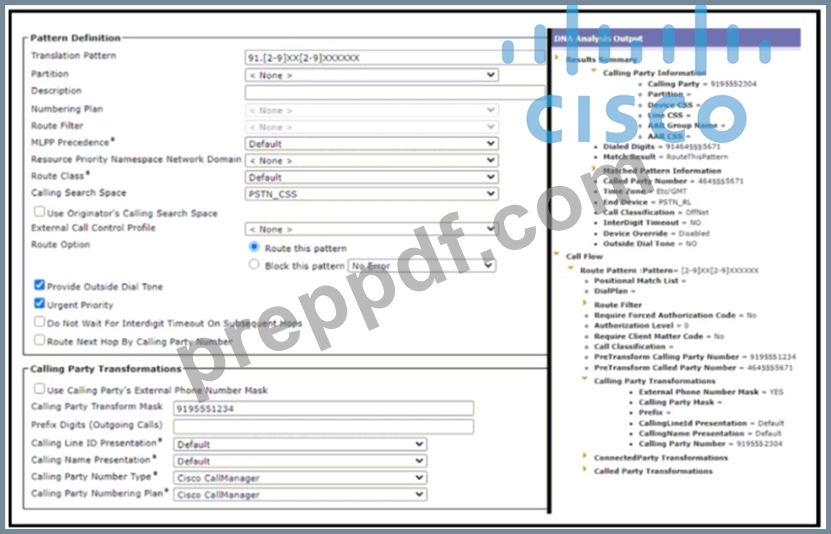
For long-distance calls, users must prefix their dialed number with "91." The translation pattern was created to strip the 91 as the PSTN expects a 10- digit number. The PSTN also requires the calling number to be set to 9195551234. However, the service provider has said calls with a different calling number are being received. How is this issue resolved?
- A. Enable Force Authorization Code on the route pattern.
- B. Disable Use Calling Party's External Phone Number Mask on the route pattern.
- C. Change the partition of the translation pattern from none to pstn_pt.
- D. Enable Use Calling Party's External Phone Number Mask on the translation pattern.
Answer: B
NEW QUESTION # 65
ABC company has decided to implement hunt groups to help distribute calls between members. In order to implement this, administrator must configure hunt list, hunt group, and line groups on Cisco UCM. Which distribution algorithms should the administrator implement?
- A. Top Down, Circular, Broadcast
- B. Top Down, Round Robin, Broadcast
- C. Top Down, Round Robin, Distribute
- D. Sequantial, Circular, Broadcast
Answer: A
NEW QUESTION # 66
Which two statements are correct with respect to the Client Matter Code setting in the route pattern configuration? (Choose two.)
- A. If you check the Allow Overlap Sending check box, the Require Client Matter Code check box becomes disabled.
- B. The Client Matter Code has the option to configure Authorization Level such as in the Forced Authorization Code.
- C. If you check the Allow Overlap Sending check box, you can also check the Require Client Matter Code check box.
- D. The Client Matter Code feature does support overlap sending because the Cisco Unified Communications Manager can determine when to prompt the user for the code.
- E. The Client Matter Code feature does not support overlap sending because the Cisco Unified CM cannot determine when to prompt the user for the code.
Answer: A,E
Explanation:
Reference:
https://www.cisco.com/c/en/us/td/docs/voice_ip_comm/cucm/admin/10_0_1/ccmfeat/ CUCM_BK_F3AC1C0F_00_cucm-features-services-guide-100/CUCM_BK_F3AC1C0F_00_cucm-features- services-guide-100_chapter_010000.pdf
NEW QUESTION # 67
When the services key is pressed Cisco Extension Mobility does not show up. What is the cause of the issue?
- A. Cisco Extension Mobility is not enabled in the Phone Configuration Window (Device > Phone)
- B. Cisco Extension Mobility Service is not running.
- C. The URL configured for Cisco Extension Mobility is not correct.
- D. The phone is not subscribed to Cisco Extension Mobility Service.
Answer: D
NEW QUESTION # 68
Refer to the exhibit.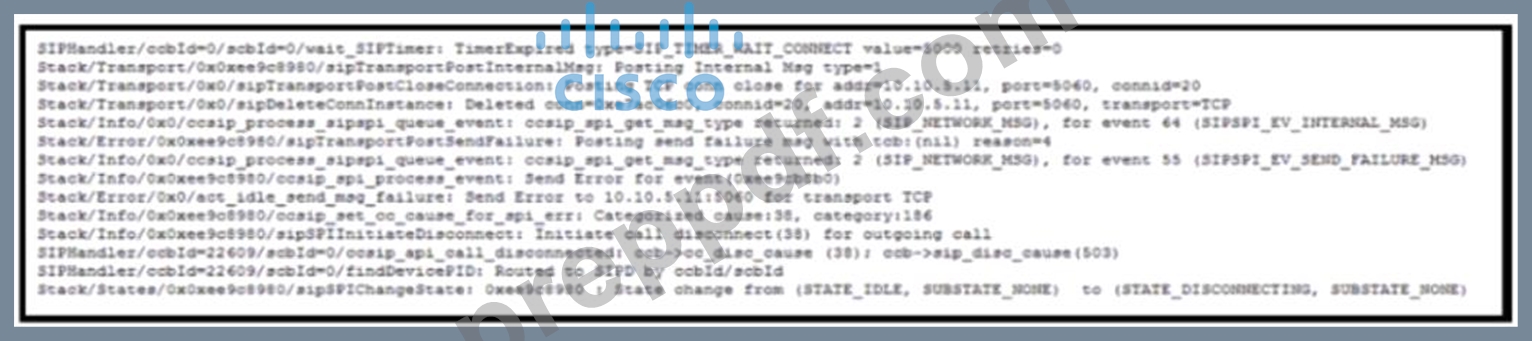
An administrator has configured a SIP trunk between two Cisco UCM clusters. For calls that should use the trunk, the calls fail with a fast busy. The administrator checks the Cisco CallManager SDL traces and found that the cluster to which the calling device is registered never sends an INVITE to the destination cluster. The administrator also verifies that all nodes from both clusters are powered on, and the CallManager service is running. How is this issue resolved?
- A. The administrator needs to enable OPTIONS pings on the SIP trunks for both clusters.
- B. The administrator must associate the route pattern with a calling search space the device can dial.
- C. The administrator needs to disable OPTIONS pings on the SIP trunks for both clusters.
- D. The administrator must allow connectivity so that TCP connections do not fail between the nodes.
Answer: D
NEW QUESTION # 69
Refer to the exhibit.
An engineer configures Cisco Unified Border Element to connect the enterprise VoIP network with a SIP telephony provider. Calls are not working in either direction. What must be configured in the dial peer 1 to fix the issue?
- A. session-protocol sipv2
- B. incoming called number 555.......
- C. answer-address 555 ........
- D. codec g729
Answer: A
NEW QUESTION # 70 
Refer to the exhibit. Users report that when they dial to Cisco Unity Connection from an external network, they cannot enter any digits. Assuming only in-band DTMF is supported, what is a reason for this malfunction?
- A. The negotiated RTP port is outside of the range described by RFC, so inband DTMFs do not work.
- B. No DTMF is negotiated.
- C. There is SIP Delayed Offer. DTMF is supported only in Early Offer.
- D. The rtpmap:0 value for the negotiated codec is marking DTMF as inactive.
Answer: B
Explanation:
Section: Signaling and Media Protocols
NEW QUESTION # 71 
Refer to the exhibit. An engineer configures Cisco Unified Border Element to connect the enterprise VoIP network with a SIP telephony provider. Calls are not working in either direction. What must be configured in the dial peer 1 to fix the issue?
- A. session-protocol sipv2
- B. answer-address 555 ........
- C. codec g729
- D. incoming called number 555.......
Answer: D
Explanation:
Section: Call Control and Dial Planning
NEW QUESTION # 72
A network engineer designs a new dial plan and wants to block a certain range of numbers (8135100 through
8135105). What is the most specific route pattern that can be configured to block only the numbers in this range?
- A. 81XXXXX
- B. 813510[12345]
- C. 813510[012345]
- D. 813510[^0-5]
Answer: C
NEW QUESTION # 73
You see the voice register pool 1 command in your Cisco Unified Communications Manager Express configuration. Which configuration is occurring in this section?
- A. configuration for SIP registrar service
- B. configuration items common for all SIP phones
- C. configuration for a pool of SIP phones (similar to device pool on Cisco Unified Communications Manager)
- D. configuration for a single SIP phone
Answer: D
NEW QUESTION # 74
Refer to the exhibit.
An administrator is troubleshooting why users are not hearing audio when dialing long distance numbers across their Cisco Unified Border Element. The customer's carrier has a requirement that dialing long distance requires an access code to be entered. Looking at the exhibit, what two actions can be taken to correct signaling? (Choose two.)
- A. Enable Mid-Call Signaling Consumption.
- B. Enable the supplementary-service media-renegotiate command.
- C. Enable Early Offer on the Cisco Unified Border Element.
- D. Enanle PRACK.
- E. Enable Media Flow Around
Answer: C,D
NEW QUESTION # 75
A user in location X dials an extension at location Y.
The call travels through a QoS-enabled WAN network, but the user experiences choppy or clipped audio. What is the cause of this issue?
- A. ptime mismatch
- B. missing Call Admission Control
- C. codec mismatch
- D. phone class of service issue
Answer: C
NEW QUESTION # 76
......
New 300-815 Exam Questions| Real 300-815 Dumps: https://passcertification.preppdf.com/Cisco/300-815-prepaway-exam-dumps.html