

Microsoft DP-300 Certification Exam Dumps with 208 Practice Test Questions
New DP-300 Exam Dumps with High Passing Rate
Configure Query Performance: 5-10%
- Review Query Plans: The test takers should be able to establish the problem areas within execution plans and determine the relevant execution plan type.
- Review Index Design & Database Table: The skills covered in this topic include evaluating index design for performance, table partitioning strategy, and compression for indexes and table usage.
- Assess Performance Improvement: The competence required in this domain includes identifying performance concerns with DMVs and evaluating the utilization of hints regarding query performance.
NEW QUESTION 17
You have SQL Server on an Azure virtual machine named SQL1.
SQL1 has an agent job to back up all databases.
You add a user named dbadmin1 as a SQL Server Agent operator.
You need to ensure that dbadmin1 receives an email alert if a job fails.
Which three actions should you perform in sequence? To answer, move the appropriate actions from the list of actions to the answer area and arrange them in the correct order.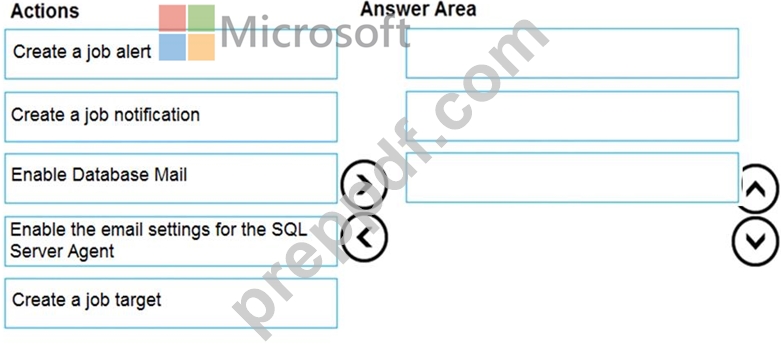
Answer:
Explanation: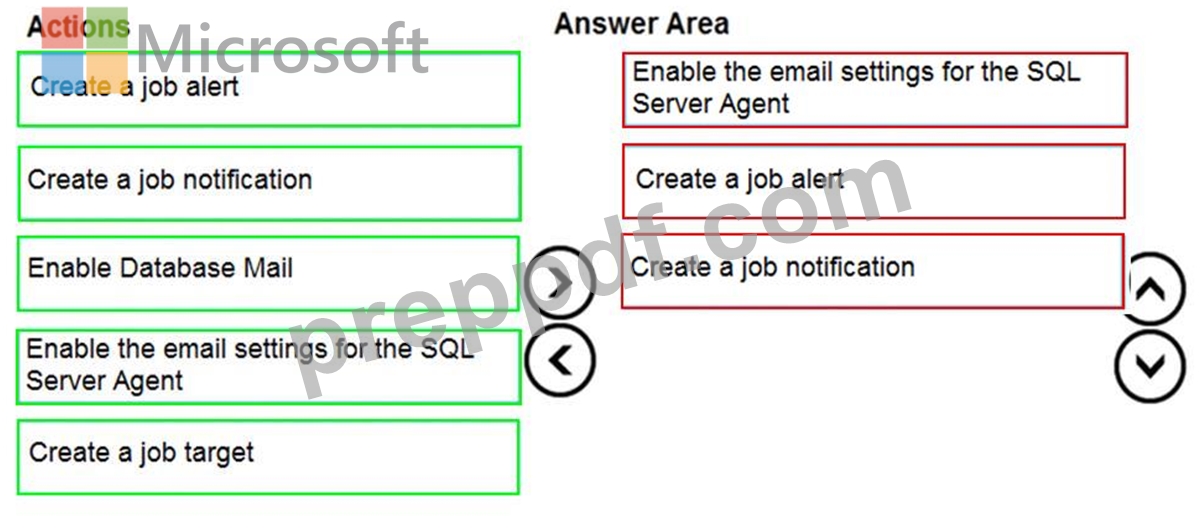
Explanation:
Step 1: Enable the email settings for the SQL Server Agent.
To send a notification in response to an alert, you must first configure SQL Server Agent to send mail.
Step 2: Create a job alert
Step 3: Create a job notification
Example:
-- adds an e-mail notification for the specified alert (Test Alert)
-- This example assumes that Test Alert already exists
-- and that Francois Ajenstat is a valid operator name.
USE msdb ;
GO
EXEC dbo.sp_add_notification
@alert_name = N'Test Alert',
@operator_name = N'Francois Ajenstat',
@notification_method = 1 ;
GO
Reference:
https://docs.microsoft.com/en-us/sql/ssms/agent/notify-an-operator-of-job-status
https://docs.microsoft.com/en-us/sql/ssms/agent/assign-alerts-to-an-operator
NEW QUESTION 18
You are building a database backup solution for a SQL Server database hosted on an Azure virtual machine.
In the event of an Azure regional outage, you need to be able to restore the database backups. The solution
must minimize costs.
Which type of storage accounts should you use for the backups?
- A. zone-redundant storage (ZRS)
- B. geo-redundant storage
- C. read-access geo-redundant storage (RA-GRS)
- D. locally-redundant storage (LRS)
Answer: C
Explanation:
Section: [none]
Explanation:
Geo-redundant storage (with GRS or GZRS) replicates your data to another physical location in the secondary
region to protect against regional outages. However, that data is available to be read only if the customer or
Microsoft initiates a failover from the primary to secondary region. When you enable read access to the
secondary region, your data is available to be read if the primary region becomes unavailable. For read access
to the secondary region, enable read-access geo-redundant storage (RA-GRS) or read-access geo-zone-
redundant storage (RA-GZRS).
Incorrect Answers:
A: Locally redundant storage (LRS) copies your data synchronously three times within a single physical location
in the primary region. LRS is the least expensive replication option, but is not recommended for applications
requiring high availability.
C: Zone-redundant storage (ZRS) copies your data synchronously across three Azure availability zones in the
primary region.
D: Geo-redundant storage (with GRS or GZRS) replicates your data to another physical location in the
secondary region to protect against regional outages. However, that data is available to be read only if the
customer or Microsoft initiates a failover from the primary to secondary region.
Reference:
https://docs.microsoft.com/en-us/azure/storage/common/storage-redundancy
NEW QUESTION 19
You deploy a database to an Azure SQL Database managed instance.
D18912E1457D5D1DDCBD40AB3BF70D5D
You need to prevent read queries from blocking queries that are trying to write to the database.
Which database option should set?
- A. PARAMETERIZATION to FORCED
- B. Delayed Durability to Forced
- C. PARAMETERIZATION to SIMPLE
- D. READ_COMMITTED_SNAPSHOT to ON
Answer: D
Explanation:
In SQL Server, you can also minimize locking contention while protecting transactions from dirty reads of uncommitted data modifications using either:
The READ COMMITTED isolation level with the READ_COMMITTED_SNAPSHOT database option set to ON.
The SNAPSHOT isolation level.
If READ_COMMITTED_SNAPSHOT is set to ON (the default on SQL Azure Database), the Database Engine uses row versioning to present each statement with a transactionally consistent snapshot of the data as it existed at the start of the statement. Locks are not used to protect the data from updates by other transactions.
Incorrect Answers:
A: When the PARAMETERIZATION database option is set to SIMPLE, the SQL Server query optimizer may choose to parameterize the queries. This means that any literal values that are contained in a query are substituted with parameters. This process is referred to as simple parameterization. When SIMPLE parameterization is in effect, you cannot control which queries are parameterized and which queries are not.
B: You can specify that all queries in a database be parameterized by setting the PARAMETERIZATION database option to FORCED. This process is referred to as forced parameterization.
C: Delayed transaction durability is accomplished using asynchronous log writes to disk. Transaction log records are kept in a buffer and written to disk when the buffer fills or a buffer flushing event takes place. Delayed transaction durability reduces both latency and contention within the system.
Some of the cases in which you could benefit from using delayed transaction durability are:
You can tolerate some data loss.
You are experiencing a bottleneck on transaction log writes.
Your workloads have a high contention rate.
Reference:
https://docs.microsoft.com/en-us/sql/t-sql/statements/set-transaction-isolation-level-transact-sql
NEW QUESTION 20
You have an Azure SQL database. The database contains a table that uses a columnstore index and is accessed infrequently.
You enable columnstore archival compression.
What are two possible results of the configuration? Each correct answer presents a complete solution.
NOTE: Each correct selection is worth one point.
- A. Queries that use the index will consume more CPU resources.
- B. The index will consume more memory.
- C. Queries that use the index will consume more disk I/O.
- D. The index will consume more disk space.
- E. Queries that use the index will retrieve fewer data pages.
Answer: A,E
Explanation:
For rowstore tables and indexes, use the data compression feature to help reduce the size of the database. In addition to saving space, data compression can help improve performance of I/O intensive workloads because the data is stored in fewer pages and queries need to read fewer pages from disk.
Use columnstore archival compression to further reduce the data size for situations when you can afford extra time and CPU resources to store and retrieve the data.
Plan and Implement a High Availability and Disaster Recovery (HADR) Environment Testlet 1 This is a case study. Case studies are not timed separately. You can use as much exam time as you would like to complete each case. However, there may be additional case studies and sections on this exam. You must manage your time to ensure that you are able to complete all questions included on this exam in the time provided.
To answer the questions included in a case study, you will need to reference information that is provided in the case study. Case studies might contain exhibits and other resources that provide more information about the scenario that is described in the case study. Each question is independent of the other questions in this case study.
At the end of this case study, a review screen will appear. This screen allows you to review your answers and to make changes before you move to the next section of the exam. After you begin a new section, you cannot return to this section.
To start the case study
To display the first question in this case study, click the Next button. Use the buttons in the left pane to explore the content of the case study before you answer the questions. Clicking these buttons displays information such as business requirements, existing environment, and problem statements. If the case study has an All Information tab, note that the information displayed is identical to the information displayed on the subsequent tabs. When you are ready to answer a question, click the Question button to return to the question.
Overview
Litware, Inc. is a renewable energy company that has a main office in Boston. The main office hosts a sales department and the primary datacenter for the company.
Physical Locations
Existing Environment
Litware has a manufacturing office and a research office is separate locations near Boston. Each office has its own datacenter and internet connection.
The manufacturing and research datacenters connect to the primary datacenter by using a VPN.
Network Environment
The primary datacenter has an ExpressRoute connection that uses both Microsoft peering and private peering.
The private peering connects to an Azure virtual network named HubVNet.
Identity Environment
Litware has a hybrid Azure Active Directory (Azure AD) deployment that uses a domain named litwareinc.com.
All Azure subscriptions are associated to the litwareinc.com Azure AD tenant.
Database Environment
The sales department has the following database workload:
* An on-premises named SERVER1 hosts an instance of Microsoft SQL Server 2012 and two 1-TB databases.
* A logical server named SalesSrv01A contains a geo-replicated Azure SQL database named SalesSQLDb1.
SalesSQLDb1 is in an elastic pool named SalesSQLDb1Pool. SalesSQLDb1 uses database firewall rules and contained database users.
* An application named SalesSQLDb1App1 uses SalesSQLDb1.
The manufacturing office contains two on-premises SQL Server 2016 servers named SERVER2 and SERVER3. The servers are nodes in the same Always On availability group. The availability group contains a database named ManufacturingSQLDb1 Database administrators have two Azure virtual machines in HubVnet named VM1 and VM2 that run Windows Server 2019 and are used to manage all the Azure databases.
Licensing Agreement
Litware is a Microsoft Volume Licensing customer that has License Mobility through Software Assurance.
Current Problems
SalesSQLDb1 experiences performance issues that are likely due to out-of-date statistics and frequent blocking queries.
Requirements
Planned Changes
Litware plans to implement the following changes:
* Implement 30 new databases in Azure, which will be used by time-sensitive manufacturing apps that have varying usage patterns. Each database will be approximately 20 GB.
* Create a new Azure SQL database named ResearchDB1 on a logical server named ResearchSrv01.
ResearchDB1 will contain Personally Identifiable Information (PII) data.
* Develop an app named ResearchApp1 that will be used by the research department to populate and access ResearchDB1.
* Migrate ManufacturingSQLDb1 to the Azure virtual machine platform.
* Migrate the SERVER1 databases to the Azure SQL Database platform.
Technical Requirements
Litware identifies the following technical requirements:
* Maintenance tasks must be automated.
* The 30 new databases must scale automatically.
* The use of an on-premises infrastructure must be minimized.
* Azure Hybrid Use Benefits must be leveraged for Azure SQL Database deployments.
* All SQL Server and Azure SQL Database metrics related to CPU and storage usage and limits must be analyzed by using Azure built-in functionality.
Security and Compliance Requirements
Litware identifies the following security and compliance requirements:
* Store encryption keys in Azure Key Vault.
* Retain backups of the PII data for two months.
* Encrypt the PII data at rest, in transit, and in use.
* Use the principle of least privilege whenever possible.
* Authenticate database users by using Active Directory credentials.
* Protect Azure SQL Database instances by using database-level firewall rules.
* Ensure that all databases hosted in Azure are accessible from VM1 and VM2 without relying on public endpoints.
Business Requirements
Litware identifies the following business requirements:
* Meet an SLA of 99.99% availability for all Azure deployments.
* Minimize downtime during the migration of the SERVER1 databases.
* Use the Azure Hybrid Use Benefits when migrating workloads to Azure.
* Once all requirements are met, minimize costs whenever possible.
NEW QUESTION 21
You have SQL Server on an Azure virtual machine that contains a database named DB1.
You view a plan summary that shows the duration in milliseconds of each execution of query 1178902 as shown in the following exhibit: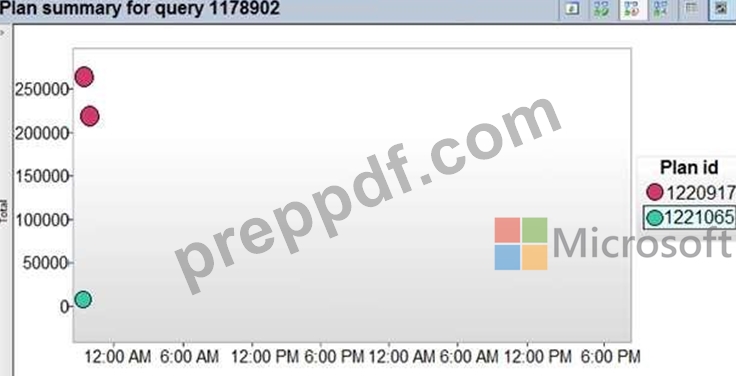
What should you do to ensure that the query uses the execution plan which executes in the least amount of time?
- A. Run the DBCC FREEPROCCACHEcommand.
- B. Disable parameter sniffing.
- C. Force the query execution plan for plan 1220917.
- D. Force the query execution plan for plan 1221065.
Answer: C
Explanation:
Explanation/Reference:
https://docs.microsoft.com/en-us/sql/relational-databases/performance/query-store-usage-scenarios
NEW QUESTION 22
You plan to move two 100-GB databases to Azure.
You need to dynamically scale resources consumption based on workloads. The solution must minimize
downtime during scaling operations.
What should you use?
- A. an Azure SQL Database managed instance
- B. SQL Server on Azure virtual machines
- C. An Azure SQL Database elastic pool
- D. Azure SQL databases
Answer: C
Explanation:
Section: [none]
Explanation:
Azure SQL Database elastic pools are a simple, cost-effective solution for managing and scaling multiple
databases that have varying and unpredictable usage demands. The databases in an elastic pool are on a
single server and share a set number of resources at a set price.
Reference:
https://docs.microsoft.com/en-us/azure/azure-sql/database/elastic-pool-overview
NEW QUESTION 23
You are designing a dimension table in an Azure Synapse Analytics dedicated SQL pool.
You need to create a surrogate key for the table. The solution must provide the fastest query performance.
What should you use for the surrogate key?
- A. a GUID column
- B. a sequence object
- C. an IDENTITY column
Answer: C
Explanation:
Dedicated SQL pool supports many, but not all, of the table features offered by other databases.
Surrogate keys are not supported. Implement it with an Identity column.
Reference:
https://docs.microsoft.com/en-us/azure/synapse-analytics/sql-data-warehouse/sql-data-warehouse-tablesoverview
NEW QUESTION 24
HOTSPOT
You configure version control for an Azure Data Factory instance as shown in the following exhibit.
Use the drop-down menus to select the answer choice that completes each statement based on the information presented in the graphic.
NOTE: Each correct selection is worth one point.
Hot Area:
Answer:
Explanation: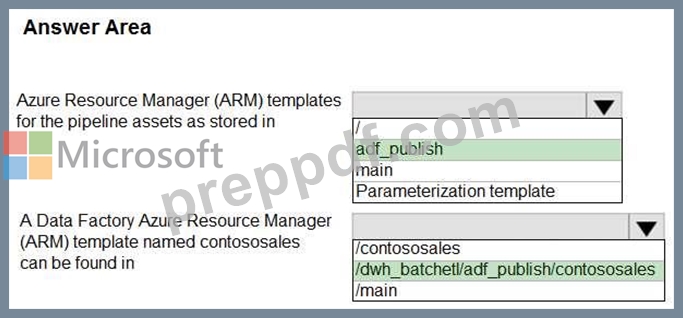
Section: [none]
Explanation:
Box 1: adf_publish
By default, data factory generates the Resource Manager templates of the published factory and saves them into a branch called adf_publish. To configure a custom publish branch, add a publish_config.json file to the root folder in the collaboration branch. When publishing, ADF reads this file, looks for the field publishBranch, and saves all Resource Manager templates to the specified location. If the branch doesn't exist, data factory will automatically create it. And example of what this file looks like is below:
{
"publishBranch": "factory/adf_publish"
}
Box 2: /dwh_barchlet/ adf_publish/contososales
RepositoryName: Your Azure Repos code repository name. Azure Repos projects contain Git repositories to manage your source code as your project grows. You can create a new repository or use an existing repository that's already in your project.
Reference:
https://docs.microsoft.com/en-us/azure/data-factory/source-control
NEW QUESTION 25
You are building a database in an Azure Synapse Analytics serverless SQL pool.
You have data stored in Parquet files in an Azure Data Lake Storage Gen2 container.
Records are structured as shown in the following sample.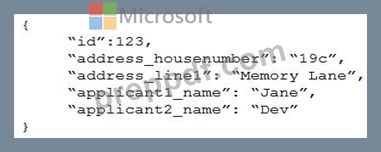
The records contain two applicants at most.
You need to build a table that includes only the address fields.
How should you complete the Transact-SQL statement? To answer, select the appropriate options in the answer area.
NOTE: Each correct selection is worth one point.
Answer:
Explanation:
Reference:
https://docs.microsoft.com/en-us/azure/synapse-analytics/sql/develop-tables-external-tables
NEW QUESTION 26
HOTSPOT
You have SQL Server on an Azure virtual machine that contains a database named Db1.
You need to enable automatic tuning for Db1.
How should you complete the statements? To answer, select the appropriate answer in the answer area.
NOTE: Each correct selection is worth one point.
Hot Area:
Answer:
Explanation: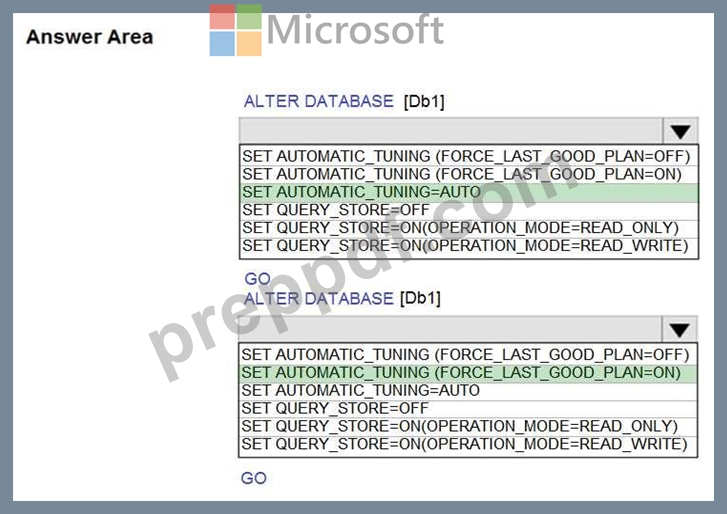
Section: [none]
Explanation:
Box 1: SET AUTOMATIC_TUNING = AUTO
To enable automatic tuning on a single database via T-SQL, connect to the database and execute the following
query:
ALTER DATABASE current SET AUTOMATIC_TUNING = AUTO
Setting automatic tuning to AUTO will apply Azure Defaults.
Box 2: SET AUTOMATIC_TUNING (FORCE_LAST_GOOD_PLAN = ON)
To configure individual automatic tuning options via T-SQL, connect to the database and execute the query
such as this one:
ALTER DATABASE current SET AUTOMATIC_TUNING (FORCE_LAST_GOOD_PLAN = ON)
Setting the individual tuning option to ON will override any setting that database inherited and enable the tuning
option. Setting it to OFF will also override any setting that database inherited and disable the tuning option.
Reference:
https://docs.microsoft.com/en-us/azure/azure-sql/database/automatic-tuning-enable
NEW QUESTION 27
Note: This question is part of a series of questions that present the same scenario. Each question in the series contains a unique solution that might meet the stated goals. Some question sets might have more than one correct solution, while others might not have a correct solution.
After you answer a question in this section, you will NOT be able to return to it. As a result, these questions will not appear in the review screen.
You have two Azure SQL Database servers named Server1 and Server2. Each server contains an Azure SQL database named Database1.
You need to restore Database1 from Server1 to Server2. The solution must replace the existing Database1 on Server2.
Solution: From Microsoft SQL Server Management Studio (SSMS), you rename Database1 on Server2 as Database2. From the Azure portal, you create a new database on Server2 by restoring the backup of Database1 from Server1, and then you delete Database2.
Does this meet the goal?
- A. Yes
- B. No
Answer: B
Explanation:
Instead restore Database1 from Server1 to the Server2 by using the RESTORE Transact-SQL command and the REPLACE option.
Note: REPLACE should be used rarely and only after careful consideration. Restore normally prevents accidentally overwriting a database with a different database. If the database specified in a RESTORE statement already exists on the current server and the specified database family GUID differs from the database family GUID recorded in the backup set, the database is not restored. This is an important safeguard.
Reference:
https://docs.microsoft.com/en-us/sql/t-sql/statements/restore-statements-transact-sql
Topic 2, Litware
Existing Environment
Network Environment
The manufacturing and research datacenters connect to the primary datacenter by using a VPN.
The primary datacenter has an ExpressRoute connection that uses both Microsoft peering and private peering. The private peering connects to an Azure virtual network named HubVNet.
Identity Environment
Litware has a hybrid Azure Active Directory (Azure AD) deployment that uses a domain named litwareinc.com. All Azure subscriptions are associated to the litwareinc.com Azure AD tenant.
Database Environment
The sales department has the following database workload:
An on-premises named SERVER1 hosts an instance of Microsoft SQL Server 2012 and two 1-TB databases.
A logical server named SalesSrv01A contains a geo-replicated Azure SQL database named SalesSQLDb1. SalesSQLDb1 is in an elastic pool named SalesSQLDb1Pool. SalesSQLDb1 uses database firewall rules and contained database users.
An application named SalesSQLDb1App1 uses SalesSQLDb1.
The manufacturing office contains two on-premises SQL Server 2016 servers named SERVER2 and SERVER3. The servers are nodes in the same Always On availability group. The availability group contains a database named ManufacturingSQLDb1 Database administrators have two Azure virtual machines in HubVnet named VM1 and VM2 that run Windows Server 2019 and are used to manage all the Azure databases.
Licensing Agreement
Litware is a Microsoft Volume Licensing customer that has License Mobility through Software Assurance.
Current Problems
SalesSQLDb1 experiences performance issues that are likely due to out-of-date statistics and frequent blocking queries.
Requirements
Planned Changes
Litware plans to implement the following changes:
Implement 30 new databases in Azure, which will be used by time-sensitive manufacturing apps that have varying usage patterns. Each database will be approximately 20 GB.
Create a new Azure SQL database named ResearchDB1 on a logical server named ResearchSrv01. ResearchDB1 will contain Personally Identifiable Information (PII) data.
Develop an app named ResearchApp1 that will be used by the research department to populate and access ResearchDB1.
Migrate ManufacturingSQLDb1 to the Azure virtual machine platform.
Migrate the SERVER1 databases to the Azure SQL Database platform.
Technical Requirements
Litware identifies the following technical requirements:
Maintenance tasks must be automated.
The 30 new databases must scale automatically.
The use of an on-premises infrastructure must be minimized.
Azure Hybrid Use Benefits must be leveraged for Azure SQL Database deployments.
All SQL Server and Azure SQL Database metrics related to CPU and storage usage and limits must be analyzed by using Azure built-in functionality.
Security and Compliance Requirements
Litware identifies the following security and compliance requirements:
Store encryption keys in Azure Key Vault.
Retain backups of the PII data for two months.
Encrypt the PII data at rest, in transit, and in use.
Use the principle of least privilege whenever possible.
Authenticate database users by using Active Directory credentials.
Protect Azure SQL Database instances by using database-level firewall rules.
Ensure that all databases hosted in Azure are accessible from VM1 and VM2 without relying on public endpoints.
Business Requirements
Litware identifies the following business requirements:
Meet an SLA of 99.99% availability for all Azure deployments.
Minimize downtime during the migration of the SERVER1 databases.
Use the Azure Hybrid Use Benefits when migrating workloads to Azure.
Once all requirements are met, minimize costs whenever possible.
NEW QUESTION 28
You manage an enterprise data warehouse in Azure Synapse Analytics.
Users report slow performance when they run commonly used queries. Users do not report performance changes for infrequently used queries.
You need to monitor resource utilization to determine the source of the performance issues.
Which metric should you monitor?
- A. DWU percentage
- B. Local tempdb percentage
- C. Data Warehouse Units (DWU) used
- D. Cache hit percentage
Answer: B
Explanation:
Section: [none]
Explanation:
Tempdb is used to hold intermediate results during query execution. High utilization of the tempdb database can lead to slow query performance.
Note: If you have a query that is consuming a large amount of memory or have received an error message related to allocation of tempdb, it could be due to a very large CREATE TABLE AS SELECT (CTAS) or INSERT SELECT statement running that is failing in the final data movement operation.
Reference:
https://docs.microsoft.com/en-us/azure/synapse-analytics/sql-data-warehouse/sql-data-warehouse-manage- monitor#monitor-tempdb
NEW QUESTION 29
Note: This question is part of a series of questions that present the same scenario. Each question in the series contains a unique solution that might meet the stated goals. Some question sets might have more than one correct solution, while others might not have a correct solution.
After you answer a question in this section, you will NOT be able to return to it. As a result, these questions will not appear in the review screen.
You have two Azure SQL Database servers named Server1 and Server2. Each server contains an Azure SQL database named Database1.
You need to restore Database1 from Server1 to Server2. The solution must replace the existing Database1 on Server2.
Solution: From Microsoft SQL Server Management Studio (SSMS), you rename Database1 on Server2 as Database2. From the Azure portal, you create a new database on Server2 by restoring the backup of Database1 from Server1, and then you delete Database2.
Does this meet the goal?
- A. Yes
- B. No
Answer: B
Explanation:
Instead restore Database1 from Server1 to the Server2 by using the RESTORE Transact-SQL command and the REPLACE option.
Note: REPLACE should be used rarely and only after careful consideration. Restore normally prevents accidentally overwriting a database with a different database. If the database specified in a RESTORE statement already exists on the current server and the specified database family GUID differs from the database family GUID recorded in the backup set, the database is not restored. This is an important safeguard.
Reference:
https://docs.microsoft.com/en-us/sql/t-sql/statements/restore-statements-transact-sql
NEW QUESTION 30
You have an Azure SQL Database managed instance named SQLMI1. A Microsoft SQL Server Agent job runs
on SQLMI1.
You need to ensure that an automatic email notification is sent once the job completes.
What should you include in the solution?
- A. From SQL Server Management Studio (SSMS), run sp_set_sqlagent_properties
- B. From the Azure portal, create an Azure Monitor action group that has an Email/SMS/Push/Voice action
- C. From SQL Server Management Studio (SSMS), create a Database Mail profile
- D. From SQL Server Configuration Manager (SSMS), enable SQL Server Agent
Answer: C
Explanation:
Section: [none]
Explanation:
To send a notification in response to an alert, you must first configure SQL Server Agent to send mail.
Using SQL Server Management Studio; to configure SQL Server Agent to use Database Mail:
1. In Object Explorer, expand a SQL Server instance.
2. Right-click SQL Server Agent, and then click Properties.
3. Click Alert System.
4. Select Enable Mail Profile.
5. In the Mail system list, select Database Mail.
6. In the Mail profile list, select a mail profile for Database Mail.
7. Restart SQL Server Agent.
Note: Prerequisites include:
* Enable Database Mail.
* Create a Database Mail account for the SQL Server Agent service account to use.
* Create a Database Mail profile for the SQL Server Agent service account to use and add the user to the
DatabaseMailUserRole in the msdb database.
* Set the profile as the default profile for the msdb database.
Reference:
https://docs.microsoft.com/en-us/sql/relational-databases/database-mail/configure-sql-server-agent-mail-to-
use-database-mail
Testlet 1
This is a case study. Case studies are not timed separately. You can use as much exam time as you
would like to complete each case. However, there may be additional case studies and sections on this exam.
You must manage your time to ensure that you are able to complete all questions included on this exam in the
time provided.
To answer the questions included in a case study, you will need to reference information that is provided in the
case study. Case studies might contain exhibits and other resources that provide more information about the
scenario that is described in the case study. Each question is independent of the other questions in this case
study.
At the end of this case study, a review screen will appear. This screen allows you to review your answers and to
make changes before you move to the next section of the exam. After you begin a new section, you cannot
return to this section.
To start the case study
To display the first question in this case study, click the Next button. Use the buttons in the left pane to explore
the content of the case study before you answer the questions. Clicking these buttons displays information such
as business requirements, existing environment, and problem statements. If the case study has an All
Information tab, note that the information displayed is identical to the information displayed on the subsequent
tabs. When you are ready to answer a question, click the Question button to return to the question.
Overview
Litware, Inc. is a renewable energy company that has a main office in Boston. The main office hosts a sales
department and the primary datacenter for the company.
Physical Locations
Existing Environment
Litware has a manufacturing office and a research office is separate locations near Boston. Each office has its
own datacenter and internet connection.
The manufacturing and research datacenters connect to the primary datacenter by using a VPN.
Network Environment
The primary datacenter has an ExpressRoute connection that uses both Microsoft peering and private peering.
The private peering connects to an Azure virtual network named HubVNet.
Identity Environment
Litware has a hybrid Azure Active Directory (Azure AD) deployment that uses a domain named litwareinc.com.
All Azure subscriptions are associated to the litwareinc.com Azure AD tenant.
Database Environment
The sales department has the following database workload:
* An on-premises named SERVER1 hosts an instance of Microsoft SQL Server 2012 and two 1-TB
databases.
* A logical server named SalesSrv01A contains a geo-replicated Azure SQL database named SalesSQLDb1.
SalesSQLDb1 is in an elastic pool named SalesSQLDb1Pool. SalesSQLDb1 uses database firewall rules
and contained database users.
* An application named SalesSQLDb1App1 uses SalesSQLDb1.
The manufacturing office contains two on-premises SQL Server 2016 servers named SERVER2 and
SERVER3. The servers are nodes in the same Always On availability group. The availability group contains a
database named ManufacturingSQLDb1
Database administrators have two Azure virtual machines in HubVnet named VM1 and VM2 that run Windows
Server 2019 and are used to manage all the Azure databases.
Licensing Agreement
Litware is a Microsoft Volume Licensing customer that has License Mobility through Software Assurance.
Current Problems
SalesSQLDb1 experiences performance issues that are likely due to out-of-date statistics and frequent blocking
queries.
Requirements
Planned Changes
Litware plans to implement the following changes:
* Implement 30 new databases in Azure, which will be used by time-sensitive manufacturing apps that have
varying usage patterns. Each database will be approximately 20 GB.
* Create a new Azure SQL database named ResearchDB1 on a logical server named ResearchSrv01.
ResearchDB1 will contain Personally Identifiable Information (PII) data.
* Develop an app named ResearchApp1 that will be used by the research department to populate and access
ResearchDB1.
* Migrate ManufacturingSQLDb1 to the Azure virtual machine platform.
* Migrate the SERVER1 databases to the Azure SQL Database platform.
Technical Requirements
Litware identifies the following technical requirements:
* Maintenance tasks must be automated.
* The 30 new databases must scale automatically.
* The use of an on-premises infrastructure must be minimized.
* Azure Hybrid Use Benefits must be leveraged for Azure SQL Database deployments.
* All SQL Server and Azure SQL Database metrics related to CPU and storage usage and limits must be
analyzed by using Azure built-in functionality.
Security and Compliance Requirements
Litware identifies the following security and compliance requirements:
* Store encryption keys in Azure Key Vault.
* Retain backups of the PII data for two months.
* Encrypt the PII data at rest, in transit, and in use.
* Use the principle of least privilege whenever possible.
* Authenticate database users by using Active Directory credentials.
* Protect Azure SQL Database instances by using database-level firewall rules.
* Ensure that all databases hosted in Azure are accessible from VM1 and VM2 without relying on public
endpoints.
Business Requirements
Litware identifies the following business requirements:
* Meet an SLA of 99.99% availability for all Azure deployments.
* Minimize downtime during the migration of the SERVER1 databases.
* Use the Azure Hybrid Use Benefits when migrating workloads to Azure.
* Once all requirements are met, minimize costs whenever possible.
NEW QUESTION 31
You are designing a dimension table in an Azure Synapse Analytics dedicated SQL pool.
You need to create a surrogate key for the table. The solution must provide the fastest query performance.
What should you use for the surrogate key?
- A. a GUID column
- B. a sequence object
- C. an IDENTITY column
Answer: C
Explanation:
Section: [none]
Explanation:
Dedicated SQL pool supports many, but not all, of the table features offered by other databases.
Surrogate keys are not supported. Implement it with an Identity column.
Reference:
https://docs.microsoft.com/en-us/azure/synapse-analytics/sql-data-warehouse/sql-data-warehouse-tables- overview
NEW QUESTION 32
You have an Azure Databricks resource.
You need to log actions that relate to changes in compute for the Databricks resource.
Which Databricks services should you log?
- A. clusters
- B. SSH
- C. DBFS
- D. jobs
- E. workspace
Answer: E
Explanation:
Section: [none]
Explanation:
Cloud Provider Infrastructure Logs.
Databricks logging allows security and admin teams to demonstrate conformance to data governance standards within or from a Databricks workspace. Customers, especially in the regulated industries, also need records on activities like:
* User access control to cloud data storage
* Cloud Identity and Access Management roles
* User access to cloud network and compute
Azure Databricks offers three distinct workloads on several VM Instances tailored for your data analytics workflow-the Jobs Compute and Jobs Light Compute workloads make it easy for data engineers to build and execute jobs, and the All-Purpose Compute workload makes it easy for data scientists to explore, visualize, manipulate, and share data and insights interactively.
Reference:
https://databricks.com/blog/2020/03/25/trust-but-verify-with-databricks.html
NEW QUESTION 33
You are designing an enterprise data warehouse in Azure Synapse Analytics that will contain a table named Customers. Customers will contain credit card information.
You need to recommend a solution to provide salespeople with the ability to view all the entries in Customers.
The solution must prevent all the salespeople from viewing or inferring the credit card information.
What should you include in the recommendation?
- A. data masking
- B. Always Encrypted
- C. row-level security
- D. column-level security
Answer: A
Explanation:
Section: [none]
Explanation:
Azure SQL Database, Azure SQL Managed Instance, and Azure Synapse Analytics support dynamic data masking. Dynamic data masking limits sensitive data exposure by masking it to non-privileged users.
The Credit card masking method exposes the last four digits of the designated fields and adds a constant string as a prefix in the form of a credit card.
Example:
XXXX-XXXX-XXXX-1234
NEW QUESTION 34
You have an Azure SQL database.
You identify a long running query.
You need to identify which operation in the query is causing the performance issue.
What should you use to display the query execution plan in Microsoft SQL Server Management Studio (SSMS)?
- A. an actual execution plan
- B. an estimated execution plan
- C. Live Query Statistics
- D. Client Statistics
Answer: A
Explanation:
Section: [none]
Explanation:
To include an execution plan for a query during execution
1. On the SQL Server Management Studio toolbar, click Database Engine Query. You can also open an existing query and display the estimated execution plan by clicking the Open File toolbar button and locating the existing query.
2. Enter the query for which you would like to display the actual execution plan.
3. On the Query menu, click Include Actual Execution Plan or click the Include Actual Execution Plan toolbar button.
Note: Actual execution plans are generated after the Transact-SQL queries or batches execute. Because of this, an actual execution plan contains runtime information, such as actual resource usage metrics and runtime warnings (if any). The execution plan that is generated displays the actual query execution plan that the SQL Server Database Engine used to execute the queries.
Reference:
https://docs.microsoft.com/en-us/sql/relational-databases/performance/display-an-actual-execution-plan
NEW QUESTION 35
You have an Azure subscription that is linked to a hybrid Azure Active Directory (Azure AD) tenant. The subscription contains an Azure Synapse Analytics SQL pool named Pool1.
You need to recommend an authentication solution for Pool1. The solution must support multi-factor authentication (MFA) and database-level authentication.
Which authentication solution or solutions should you include in the recommendation? To answer, select the appropriate options in the answer area.
NOTE: Each correct selection is worth one point.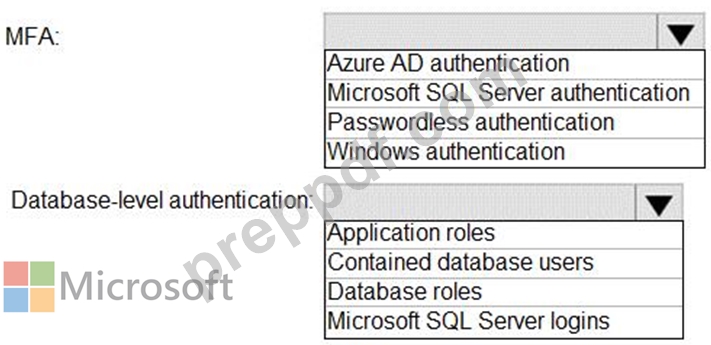
Answer:
Explanation:
Reference:
https://docs.microsoft.com/en-us/azure/synapse-analytics/sql-data-warehouse/sql-data-warehouse-authentication
NEW QUESTION 36
You have 10 Azure virtual machines that have SQL Server installed.
You need to implement a backup strategy to ensure that you can restore specific databases to other SQL Server instances. The solution must provide centralized management of the backups.
What should you include in the backup strategy?
- A. Automated Backup in the SQL virtual machine settings
- B. Azure Site Recovery
- C. SQL Server Agent jobs
- D. Azure Backup
Answer: D
Explanation:
Azure Backup provides an Enterprise class backup capability for SQL Server on Azure VMs. All backups are stored and managed in a Recovery Services vault. There are several advantages that this solution provides, especially for Enterprises.
Reference:
https://docs.microsoft.com/en-us/azure/azure-sql/virtual-machines/windows/backup-restore#azbackup
NEW QUESTION 37
You have a Microsoft SQL Server 2019 instance in an on-premises datacenter. The instance contains a 4-TB
database named DB1.
You plan to migrate DB1 to an Azure SQL Database managed instance.
What should you use to minimize downtime and data loss during the migration?
- A. distributed availability groups
- B. Database Migration Assistant
- C. database mirroring
- D. log shipping
Answer: A
Explanation:
Section: [none]
Explanation:
The Data Migration Assistant (DMA) helps you upgrade to a modern data platform by detecting compatibility
issues that can impact database functionality in your new version of SQL Server or Azure SQL Database. DMA
recommends performance and reliability improvements for your target environment and allows you to move
your schema, data, and uncontained objects from your source server to your target server.
Note: SQL Managed Instance supports the following database migration options (currently these are the only
supported migration methods):
* Azure Database Migration Service - migration with near-zero downtime.
* Native RESTORE DATABASE FROM URL - uses native backups from SQL Server and requires some
downtime.
Reference:
https://docs.microsoft.com/en-us/sql/dma/dma-overview
NEW QUESTION 38
You have an Azure SQL database.
Users report that the executions of a stored procedure are slower than usual. You suspect that a regressed query is causing the performance issue.
You need to view the query execution plan to verify whether a regressed query is causing the issue. The solution must minimize effort.
What should you use?
- A. Extended Events in Microsoft SQL Server Management Studio (SSMS)
- B. Query Performance Insight in the Azure portal
- C. Query Store in Microsoft SQL Server Management Studio (SSMS)
- D. Performance Recommendations in the Azure portal
Answer: C
Explanation:
Section: [none]
Explanation:
Use the Query Store Page in SQL Server Management Studio.
Query performance regressions caused by execution plan changes can be non-trivial and time consuming to resolve.
Since the Query Store retains multiple execution plans per query, it can enforce policies to direct the Query Processor to use a specific execution plan for a query. This is referred to as plan forcing. Plan forcing in Query Store is provided by using a mechanism similar to the USE PLAN query hint, but it does not require any change in user applications. Plan forcing can resolve a query performance regression caused by a plan change in a very short period of time.
Reference:
https://docs.microsoft.com/en-us/sql/relational-databases/performance/monitoring-performance-by-using-the- query-store
NEW QUESTION 39
......
Get DP-300 Braindumps & DP-300 Real Exam Questions: https://passcertification.preppdf.com/Microsoft/DP-300-prepaway-exam-dumps.html