

Salesforce Salesforce-MuleSoft-Developer-I Certification Exam Dumps with 237 Practice Test Questions
New Salesforce-MuleSoft-Developer-I Exam Dumps with High Passing Rate
NEW QUESTION # 88
Refer to the exhibits.


The Batch Job scope contains two Batch Step scopes with different accept expressions.
The input payload is passed to the Batch Job scope.
After the entire payload is processed by the Batch Job scope, what messages have been logged by the Logger components?
A)
B)

D)
- A. Option A
- B. Option D
- C. Option B
- D. Option C
Answer: D
NEW QUESTION # 89
Refer to the exhibits.

A web client submits a request to the HTTP Listener and the HTTP Request throws an error.
What payload and status code are returned to the web client?
Refer to the exhibits. A web client submits a request to the HTTP Listener and the HTTP Request throws an error.
What payload and status code are returned to the web client?
- A. Response body: "Success - End" Default response status code: 200
- B. Error response body: error, description Default error response status code: 500
- C. Response body: "Success - Begin* Default response status code: 200
- D. Response body: "Error" Default response status code: 200
Answer: D
Explanation:
Correct Answer: Response body: "Error" Default response status code: 200.
-------------------------------------------------------------------------------------------------------------------------------------------------
1) Payload is successfully set to "Success - Started Flow"
2) When HTTP Request throws an error, execution halts
#[error.description] = "ABC"
#[error.errorType] = "XYZ"
3) The On Error Continue scope handles the error. When On Error Continue scope is invoked, all the processors in error block are executed and success response is sent back to the client with payload which is set in error flow. In this case payload is set to "Error" value in error block.
4) "Error" is returned to the requestor in the body of the HTTP request with HTTP Status Code: 200 as On error continue always sends success error code.
Reference Diagram:
NEW QUESTION # 90
What is the object type returned by the File List operation?
- A. Array of Mule event objects
- B. Array of String file names
- C. Object of String file names
- D. Object of Mule event objects
Answer: A
Explanation:
The List operation returns an array of messages in which: Each message holds the file's content in its payload. The file's attributes section carries the file's metadata (such as name, creation time, and size). The payload is empty if the element is a folder.
NEW QUESTION # 91
Refer to the exhibits.

A web client submits a request to http://localhQst:8081. What is the structure of the payload at the end of the flow?
- A.

- B.

- C.

- D.

Answer: C
Explanation:
Scatter-Gather Router
The Scatter-Gather component is a routing event processor that processes a Mule event through different parallel processing routes that contain different event processors. Each route receives a reference to the Mule event and executes a sequence of one or more event processors. Each of these routes uses a separate thread to execute the event processors, and the resulting Mule event can be either the same Mule event without modifications or a new Mule event with its own payload, attributes, and variables. The Scatter-Gather component then combines the Mule events returned by each processing route into a new Mule event that is passed to the next event processor only after every route completes successfully.
The Scatter-Gather component executes each route in parallel, not sequentially. Parallel execution of routes can greatly increase the efficiency of your Mule application and may provide more information than sequential processing.
Mule Ref Doc : https://docs.mulesoft.com/mule-runtime/4.3/scatter-gather-concept
NEW QUESTION # 92
A shopping API contains a method to look up store details by department To get information for a particular store, web clients will submit requests with a query parameter named department and a URI parameter named storeld.
What is a valid RAML snippet that supports requests from web clients to get data for a specific storeld and department name?
- A.

- B.

- C.

- D.

Answer: D
Explanation:
Lets revise few concepts RAML which can help us to find the answer of this question.
URI Parameters
Lets have a look at below example.
/foos:
/{id}:
/name/{name}:
Here, the braces { } around property names define URI parameters. They represent placeholders in each URI and do not reference root-level RAML file properties as we saw above in the baseUri declaration. The added lines represent the resources /foos/{id} and /foos/name/{name}.
Query Parameters
Now we'll define a way to query the foos collection using query parameters. Note that query parameters are defined using the same syntax that we used above for data types:
/foos:
get:
description: List all Foos matching query criteria, if provided;
otherwise list all Foos
queryParameters:
name?: string
ownerName?: string
Based on the above information , below is the only option which defines storeid as uri parameter and department as query parameter.
/{storeId}:
get:
queryParameter:
department:
NEW QUESTION # 93
Refer to the exhibits.
The two Mule configuration files belong to the same Mule project. Each HTTP Listener is configured with the same host string and the port number, path, and operation values are shown in the display names.
What is the minimum number of global elements that must be defined to support all these HTTP Listeners?
- A. 0
- B. 1
- C. 2
- D. 3
Answer: B
Explanation:
In this case three configurations will be required each for port 8000, 6000 and 7000.
There would be three global elements defined for HTTP connections.
Each HTTP connection will have host and port. One example shown below with host as localhost and port 6000
To use an HTTP listener, you need to declare a configuration with a corresponding connection. This declaration establishes the HTTP server that will listen to requests.
Additionally, you can configure a base path that applies to all listeners using the configuration.
<http:listener-config name="HTTP_Listener_config" basePath="api/v1">
<http:listener-connection host="0.0.0.0" port="8081" />
</http:listener-config>
https://docs.mulesoft.com/http-connector/1.6/http-listener-ref#http-listener-configuration
NEW QUESTION # 94
Refer to the exhibits.
What is the response when a client submits a request to http://localhost:8081?
- A. Before
- B. Validation error
- C. null
- D. After
Answer: B
Explanation:
----------------------------------------------------------------------------------------------------------------------------------- Here's specifically what is happening here:
1) Payload is successfully set to "Before"
2) Is null validation is used which will pass the message only if payload is null. In this case as payload is not null, it creates an Error Object. Flow execution stops
#[error.description] = "Validation error"
3) Because no error handler is defined, the Mule default error handler handles the error
4) "Validation error" is the error message returned to the requestor in the body of the HTTP request with HTTP Status Code: 500 Reference diagram:
NEW QUESTION # 95
A Database On Table Row listener retrieves data from a CUSTOMER table that contains a primary key userjd column and an increasing kxjin_date_time column. Neither column allows duplicate values.
How should the listener be configured so it retrieves each row at most one time?
- A. Set the target value to the last retrieved login_date_time value
- B. Set the watermark column to the bgin_date_time column
- C. Set the target value to the last retrieved user_jd value
- D. Set the watermark column to the user_Id column
Answer: B
Explanation:
* Watermark allows the poll scope to poll for new resources instead of getting the same resource over and over again.
* The database table must be ordered so that the "watermark functionality" can move effectively in the ordered list. Watermark stores the current/last picked up "record id."
* If the Mule application is shut down, it will store the last picked up "record id" in the Java Object Store and the data will continue to exist in the file. This watermark functionality is valuable and enables developers to have increased transparency.
* Developers do not need to create code to handle caching; it is all configurable!
* There are two columns and both are unique but user_id can't guaranty sequence whereas date_time will always be in increasing order and table content can easily be ordered on the basis of last processed date_time.
So correct answer is: Set the watermark column to the date_time column
NEW QUESTION # 96
Refer to the exhibits.
What is written to the records.csv file when the flow executes?
- A. An error message
- B. Nothing
- C. The JSON payload
- D. The payload convert to CVS
Answer: C
Explanation:
Transform Message Add write_date is coverting payload in JSON format and same JSON payload is avaialble to file write processor. However, if the payload is a different format (for example, not CSV) , you can place the transformation inside the Write operation to generate content that will be written without producing a side effect on the message in transit. This is not done in this case. By default, the connector writes whatever is in the message payload. Hence JSON payload will be written to file.
NEW QUESTION # 97
By default, what happens to a file after it is read using an FTP connector Read operation?
- A. The file stays in the same folder unchanged
- B. The file is deleted from the folder
- C. The file is renamed in the same folder
- D. The file is moved to a different folder
Answer: A
Explanation:
File is not updated when FTP read operations is performed.
MuleSoft Doc Ref : https://docs.mulesoft.com/file-connector/1.3/file-read
NEW QUESTION # 98
How would you debug Mule applications?
- A. Checking RAML specifications
- B. By Deploying apps on production
- C. Using debugger component
- D. Use third party debugger application
Answer: C
Explanation:
Debugger can be used to debug applications to see event data movine from one flow to other
NEW QUESTION # 99
A Mule application configured with Autodiscovery implements an API.
Where is governance enforced for policies defined for this Mule application?
- A. In the Mule application
- B. In Runtime Manager
- C. In API manager
- D. Runtime Manager
Answer: C
Explanation:
Correct answer is API manager
NEW QUESTION # 100
Refer to the exhibits.
Larger image
Larger image
Larger image
The Mule application configures and uses two HTTP Listener global configuration elements.
Mule application is run in Anypoint Studio.
If the mule application starts correctly, what URI and port numbers can receive web client requests? If the mule applications fails to start , what is the reason for the failure?
- A. The mule application start successfully
Web client requests can only be received at URI on port 2222 but not on port 3333 - B. The mule application fails to start because of the port binding conflict as HTTP request also use same port i.e. 3333
- C. The mule application fails to start
There is URL path conflict because both HTTP Listeners are configured with same path - D. The mule application start successfully
Web client requests can be received at URI on port 2222 and on port 3333.
Answer: D
Explanation:
In this case both the flows can start without any error and requests can be received on both ports. Flow names httpListener1 can call other flow using HTTP request without any issues.
Hence correct answer is
The mule application start successfully
Web client requests can be received at URI on port 2222 and on port 3333.
Lets check why other options are incorrect
1) The mule application fails to start. There is URL path conflict because both HTTP Listeners are configured with same path ---- This is incorrect as port value is different in both listeners
2) The mule application start successfully. Web client requests can only be received at URI on port 2222 but not on port 3333 --- This is incorrect as there is no reason for not receiving requests on port 3333
3) The mule application fails to start because of the port binding conflict as HTTP request also use same port i.e. 3333 --- Port binding conflict will not happen in this case. It would have if both listener configurations would have been on same port . But that is not the case here.
Mule Ref Doc : HTTP Listener Reference - Mule 4 | MuleSoft Documentation
NEW QUESTION # 101
Refer to the exhibit.
What should be changed to fix the 415 error?
- A. set the response Content-Type header to text/plain
- B. set the response Content-Type header to application/json
- C. set the request Content-Type header to text/plain
- D. Set the request Content-Type header to application/] son
Answer: D
Explanation:
The HTTP 415 Unsupported Media Type client error response code indicates that the server refuses to accept the request because the payload format is in an unsupported format. The format problem might be due to the request's indicated Content-Type or Content-Encoding , or as a result of inspecting the data directly. In this case as per RAML specification data is expected in application/json and in request Content-Type is set as "text/plain" which is incorrect. Hence solution is set the request Content-Type header to application/json
https://developer.mozilla.org/en-US/docs/Web/HTTP/Status/415
NEW QUESTION # 102
Correct answer is {customerID}.
- A. var toUpper(userName) -> upper(userName)
- B. fun toUpper(userName) -> upper(userName)
- C. fun toUpper(userName) = upper(userName)
- D. var toUpper(userName) = upper(userName)
Answer: C
Explanation:
Reference:
A function named toUpper needs to be defined that accepts a string named userName and returns the string in uppercase.
What is the correct DW code to define the toUpper function?
NEW QUESTION # 103
Refer to the exhibits.

Mule application has an HTTP request configuration where host name is hardcoded. Organization is looking to move host and port values to configuration file. What valid expression can be used to so that HTTP configuration can pick the value from configuration file?
- A. ${training.host}
- B. ${http.host}
- C. #[training.host]
- D. #{training.host}
Answer: A
Explanation:
Correct answer is ${training.host}
NEW QUESTION # 104
Refer to the exhibits. The main flow contains an HTTP Request operation configured to call the child flow's HTTP Listener.
A web client sends a GET request to the HTTP Listener with the sty query parameter set to 30.
After the HTTP Request operation completes, what parts of the Mule event at the main flow's Logger component are the same as the Mule event that was input to the HTTP Request operation?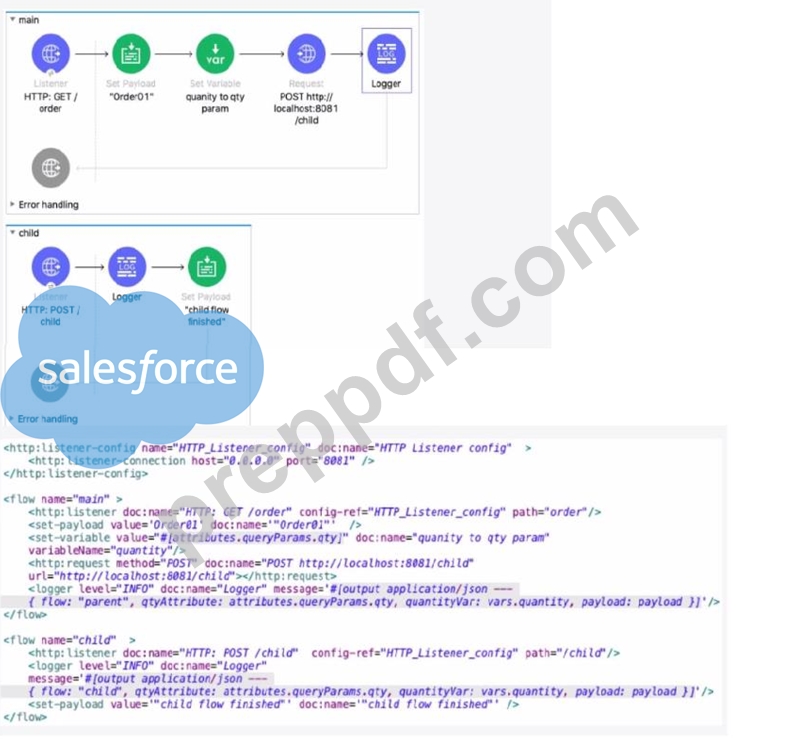
- A. All variables
- B. The entire Mule event
- C. The payload and all attributes
- D. The payload and all variables
Answer: D
NEW QUESTION # 105
A Mule project contains a DataWeave module file WebStore dvA that defines a function named loginUser The module file is located in the projects src/main/resources/libs/dw folder What is correct DataWeave code to import all of the WebStore.dwl file's functions and then call the loginUser function for the login "[email protected]"?
A)
B)
C)

- A. Option A
- B. Option B
- C. Option D
- D. Option C
Answer: C
NEW QUESTION # 106
Refer to the exhibits.
In the requestFlow an HTTP Request operation is configured to send an HTTP request with an XML payload. The request is sent to the HTTP Listener in the transform Flow.
That flow transforms the incoming payload into JSON format and returns the response to the HTTP request. The response of the request is stored in a target variable named the Result.
What is the payload at the Logger component after the HTTP Request?
- A. A non-empty Java object
- B. The original XML payload
- C. The returned JSON response
- D. null
Answer: B
NEW QUESTION # 107
......
Salesforce Salesforce-MuleSoft-Developer-I Exam Syllabus Topics:
| Topic | Details |
|---|---|
| Topic 1 |
|
| Topic 2 |
|
| Topic 3 |
|
| Topic 4 |
|
| Topic 5 |
|
| Topic 6 |
|
Get Salesforce-MuleSoft-Developer-I Braindumps & Salesforce-MuleSoft-Developer-I Real Exam Questions: https://passcertification.preppdf.com/Salesforce/Salesforce-MuleSoft-Developer-I-prepaway-exam-dumps.html